

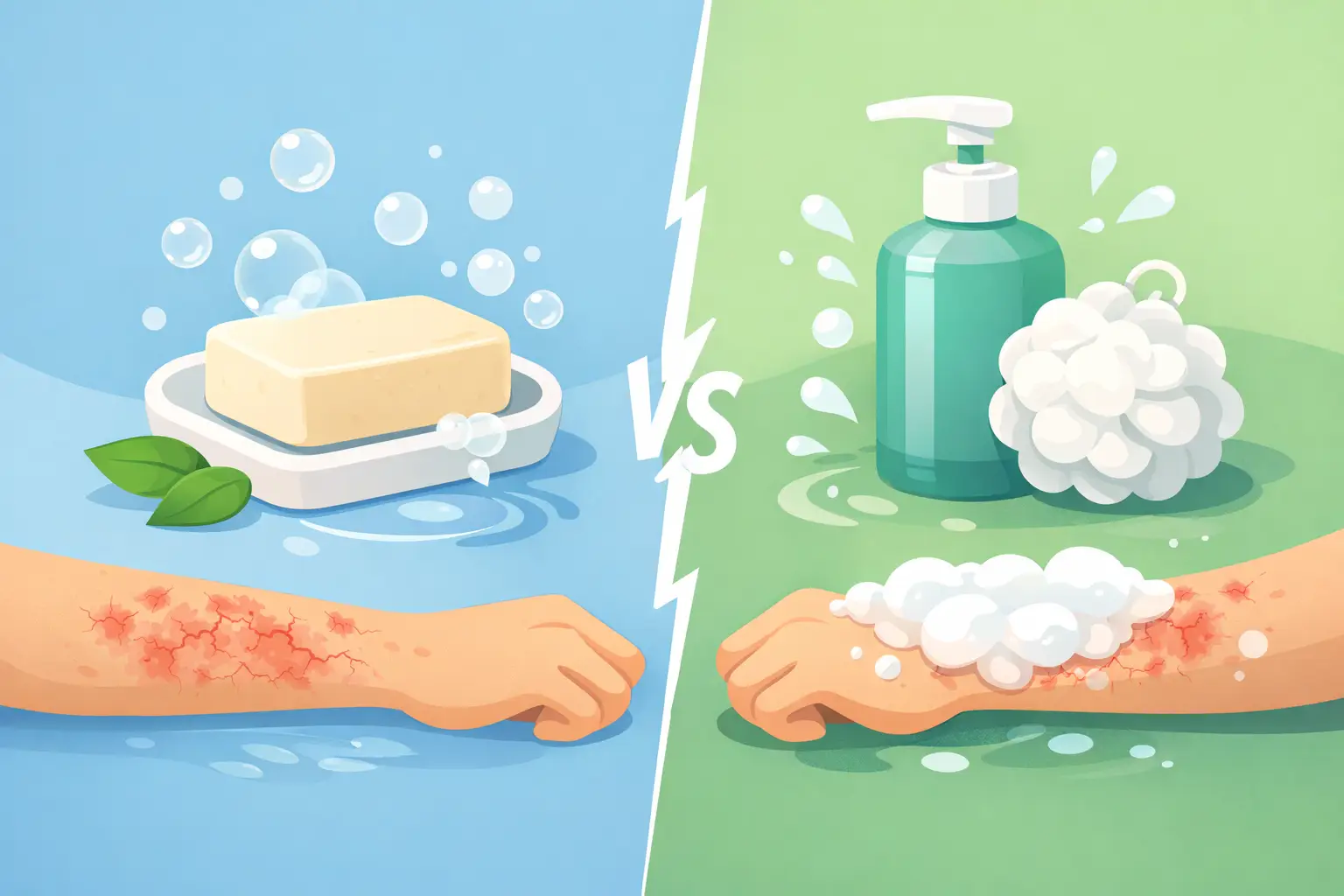
If your skin stings the moment water hits it, the bar-or-bottle question stops being cosmetic. It becomes practical. When people compare bar soap vs body wash for eczema, what they usually want to know is simple: which one will cleanse without leaving skin tighter, itchier, and more irritated than before.
The honest answer is that eczema-prone skin rarely responds well to marketing terms alone. A product can come in a bar and still be too harsh. It can come in a bottle and still be packed with detergents, fragrance, and preservatives that unsettled skin does not need. Format matters, but formula matters more.
Bar soap vs body wash for eczema: what actually matters
Eczema is, at heart, a barrier problem. Skin loses moisture too easily and reacts too quickly. That means cleansing needs to do two things at once: remove dirt, sweat, and sunscreen without stripping the oils and lipids your skin is already struggling to hold onto.
This is where people get confused by the word soap. Traditional soap has a reputation for being drying, and sometimes that reputation is deserved. Many high-street bars are made to feel squeaky clean. For eczema-prone skin, squeaky is usually not the goal. Clean should feel calm, comfortable, and soft after rinsing.
Body wash often gets positioned as the gentler option, largely because it feels more moisturising on the skin. Sometimes that is true. Many body washes include humectants and emollients that leave a softer after-feel. But many also rely on strong surfactants, synthetic fragrance, and long ingredient lists that sensitive skin may not appreciate.
A well-formulated bar can be a better choice than a poorly formulated body wash. Equally, a mild fragrance-free body wash can suit some people better than a strongly scented artisan bar. Eczema does not reward assumptions.
Why some bars work beautifully and others do not
A good bar for dry, reactive skin tends to be simple, well-cured, and made with skin-compatible fats. That is one reason traditional soapmaking still has a place. When a bar is made with nourishing fats and allowed the proper curing time, it can cleanse gently while offering a richer, creamier lather than many people expect.
Tallow-based soap is especially worth understanding here. Tallow has a fatty acid profile that sits remarkably well with human skin, and it naturally contains vitamins A, D, E, K and B12. For skin that is dry, fragile, or prone to flare-ups, that matters. The goal is not to coat the skin in a miracle ingredient. The goal is to choose a cleanser that works with the barrier rather than constantly against it.
That said, not every natural bar is automatically eczema-friendly. Essential oils can be irritating for some people, even when they smell beautiful and come from a natural source. Strong exfoliants can be too much during a flare. Some bars are simply over-cleansing.
For eczema-prone skin, the best bars are usually the quiet ones – minimal ingredients, no aggressive fragrance, and a creamy rather than sharp cleanse.
Signs a bar may suit eczema-prone skin
Look for a short, intelligible ingredient list and fats known for barrier support. Oatmeal, goat milk, and traditionally rendered tallow are often appreciated by dry, sensitive skin. Also pay attention to how your skin feels twenty minutes after washing. That delayed feeling tells you more than the lather ever will.
If your skin feels taut, hot, or itchy once it has dried, the cleanser is likely too harsh, no matter how luxurious it seemed in the shower.
When body wash is the better option
Body wash can be helpful when skin is actively flaring, broken, or highly reactive and you need the mildest possible cleansing step. Some people also find liquids easier to distribute over the body without friction, which can matter when skin is sore.
Another advantage is consistency. Body washes formulated for sensitive skin are often built around synthetic surfactants chosen specifically to be milder than traditional soap. If they are fragrance-free and low in unnecessary additives, they can be a sensible choice during difficult periods.
But there is a trade-off. Liquid formulas need preservatives to remain safe once opened. That is not a flaw – it is simply chemistry. Still, every extra component is another potential issue for very reactive skin. Many body washes also come in plastic packaging, which may matter if you are trying to reduce waste at home.
For some households, the best answer is not bar or body wash forever. It is using a very mild body wash during a flare, then returning to a simple, nourishing bar when skin is steadier.
Ingredients to avoid if you have eczema
The common troublemakers are not always dramatic. Often, they are the things added for scent, foam, colour, or shelf appeal.
Fragrance is the big one, whether synthetic or natural. Essential oils can be lovely in the right product, but eczema-prone skin often prefers less stimulation, not more. Harsh sulphates can also leave skin feeling stripped. Strong exfoliating acids, gritty scrubs, and heavily dyed products are best approached with caution.
Preservatives and surfactants are more nuanced. Some people tolerate them perfectly well. Others do not. If you are trying to work out what is setting your skin off, the simplest formula is usually the most useful place to start.
How to choose between bar soap and body wash for eczema
Start with your skin’s current condition, not with loyalty to a format.
If your eczema is active, skin is cracked, and even light products sting, a very mild, fragrance-free body wash or wash cream may be the safest short-term option. You want the least friction and the least interference.
If your skin is dry, sensitive, but relatively stable, a well-made bar with nourishing fats and minimal ingredients may serve you beautifully. This is especially true if you want a plastic-free routine and a cleanser that feels both practical and indulgent.
If you are buying for children or for the whole family, simplicity matters even more. A single gentle cleanser that works for most skin types is often better than a bathroom full of half-used products. The best routine is the one people will actually stick with.
Patch testing still matters
Even the gentlest-looking cleanser can be wrong for your skin. Try any new product on a small area first for a few days, especially if you are prone to flares. Eczema has a way of turning a small mismatch into a much bigger complaint.
The case for a traditional bar in a modern bathroom
For many people, bars have been unfairly dismissed as old-fashioned or harsh. In reality, a thoughtfully made traditional bar can be exactly what sensitive skin has been missing. Fewer ingredients. No plastic bottle. A firm bar that lasts well. A cleansing experience that feels grounded rather than over-engineered.
That is part of why so many people with dry, troubled skin come back to slow-made soap once they find the right one. Not because it is trendy, but because it is straightforward. Good ingredients, properly handled, often do less damage than complicated formulas designed to sound impressive.
At Luna Natural Soap Co., that belief sits at the centre of the craft. Slow-rendered tallow, careful formulation, and small-batch methods are not there for romance alone. They are there because skin notices the difference.
So which wins: bar soap or body wash?
If you want a single verdict in the bar soap vs body wash for eczema debate, here it is: neither wins on format alone.
The better choice is the cleanser that leaves your skin clean but settled, soft rather than tight, and able to hold moisture once you step out of the shower. For many people, that will be a plain, nourishing bar made with traditional fats and without heavy fragrance. For others, especially during a flare, it will be a very mild body wash with as few triggers as possible.
The smartest approach is to stop asking whether bars or bottles are better in theory and start asking whether the formula respects your skin barrier in practice.
Choose the cleanser that feels calm on your worst skin day, not just your best one.