

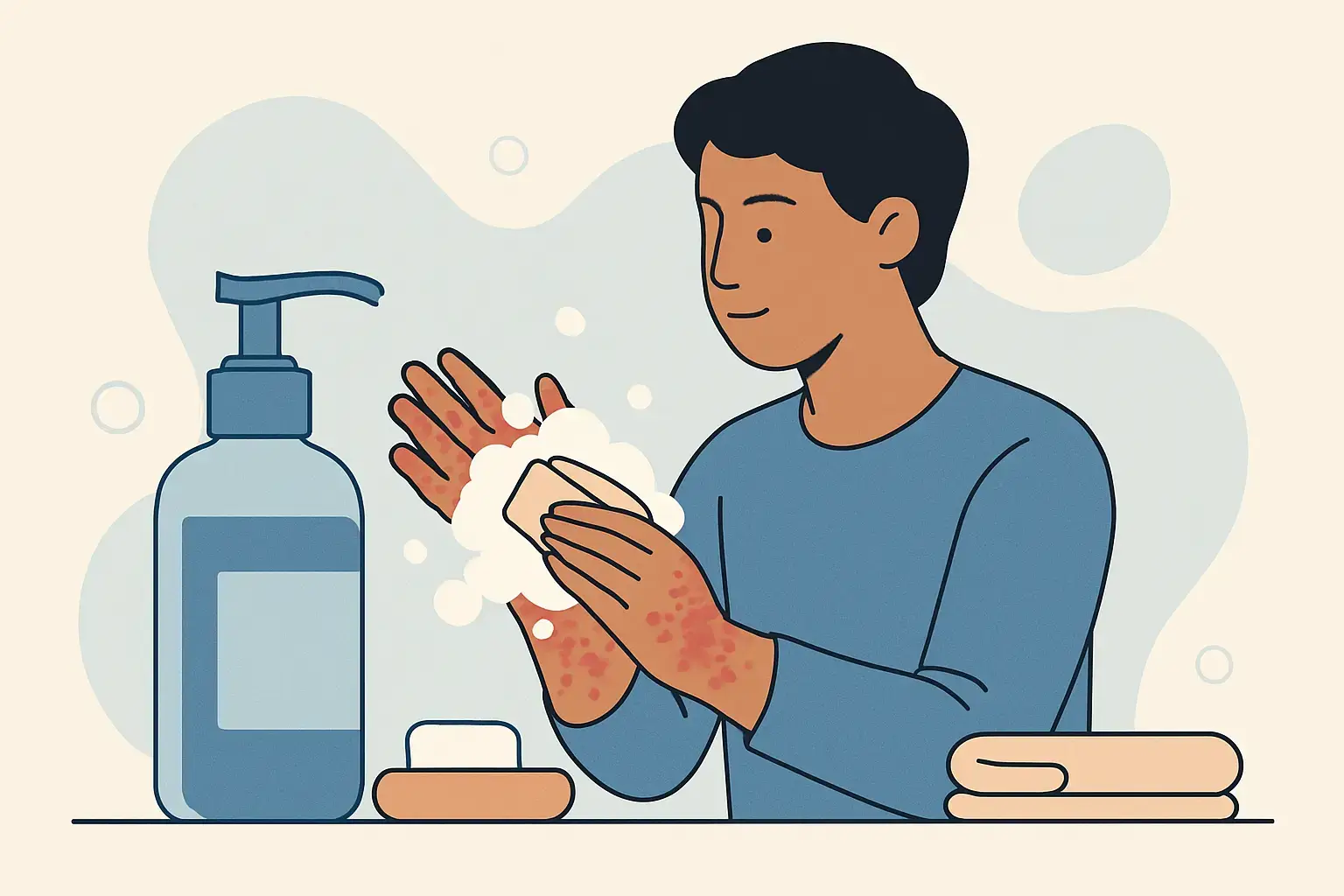
Your skin flares, so you swap your soap. It helps for a week, then the dryness creeps back in – tightness after the shower, itching at night, and that familiar sting when you moisturise. For a lot of eczema-prone people, it is not just the soap. It is the routine around it: water temperature, frequency, rubbing, towels, and the product you put on in the first three minutes after drying.
This is a practical, real-life eczema friendly soap routine example you can copy, then adjust based on what your skin tells you.
Why soap is often the trigger (and why it is not always the villain)
Eczema-prone skin usually has a weaker barrier. Think of it as the mortar between bricks: when it is compromised, water escapes more easily and irritants get in more easily. Cleansing can aggravate that in two main ways – by stripping too much oil and by leaving behind ingredients that irritate.
That does not mean you must avoid washing. It means you want cleansing that is deliberate, minimal, and consistent. A gentler bar can be part of that, especially if it is made with a higher proportion of nourishing fats and without the foaming detergents found in many liquid washes.
The trade-off is real: the gentlest routine can sometimes feel less “squeaky clean”, and if you are active, sweaty, or dealing with body acne as well as eczema, you may need to be more targeted rather than simply using more cleanser everywhere.
The eczema friendly soap routine example (morning to night)
Morning: rinse-first, cleanse only where needed
On calmer days, start with a short lukewarm rinse rather than a full wash. For many people with eczema, morning cleansing is where unnecessary stripping happens, because you are washing off… very little.
If you do need soap in the morning, keep it to the areas that actually collect sweat and odour: underarms, groin, feet, and any skin folds. Use the bar on your hands or a soft cloth, build a light lather, then apply with your palms. Skip vigorous scrubbing. It feels satisfying, but it is often the moment you pay for later.
Aim for under two minutes in the water. Pat dry with a clean towel – do not rub – and leave the skin slightly damp.
Now the most important part: moisturise straight away. A simple, fragrance-free cream or balm tends to be better tolerated than something full of essential oils, even if those oils are “natural”. Eczema skin is not judging the marketing, it is reacting to chemistry.
During the day: hands are the hardest-working eczema zone
Hand eczema is common because we wash our hands often, and then we touch everything – shopping trolleys, door handles, steering wheels, pets. The routine here matters more than the product label.
Wash hands in lukewarm water, not hot. Use a small amount of gentle soap. Rinse thoroughly, because residue can irritate as much as the cleanser itself. Pat dry, then apply moisturiser every time you wash, even if it is just a pea-sized amount.
If you are washing up or using cleaning sprays, wear gloves. “Gentle” soap cannot outwork repeated exposure to detergents.
Evening: the main cleanse, kept calm and short
Make the evening your proper wash, because it is when you need to remove sunscreen, city grime, sweat, and whatever the day left behind. Still, keep it brief.
Set your shower to lukewarm. Hot water can feel soothing in the moment, then leave you drier and itchier afterwards. Five to eight minutes is plenty for eczema-prone skin.
Use your bar in your hands rather than rubbing it directly on the body, particularly over active patches. If you have flare areas, treat them like bruises – cleanse around them gently, and let the water run over.
When you finish, pat dry and moisturise within three minutes. That timing is not a gimmick. Hydrating while your skin is still slightly damp helps trap water in the outer layer.
If you are managing eczema and also shaving, shave at the end of the shower, not the beginning. Softened hair needs less friction. Use a simple shaving medium that does not contain fragrance, and moisturise afterwards.
Night: reduce itch, reduce reactivity
If night itching is your issue, it often helps to add one calm step rather than switching ten products. Try a slightly richer moisturiser on your problem areas before bed, and keep nails short to reduce damage from unconscious scratching.
If your bedding is a trigger, consider washing sheets in a fragrance-free detergent and skipping fabric conditioner. Skin that is already on high alert does not need perfume marinating into cotton fibres.
Choosing a bar: what “eczema-friendly” usually means in practice
People often ask for the single best soap for eczema. The honest answer is: it depends. Eczema is a pattern of sensitivity, not one identical condition. But there are sensible principles.
Look for a bar that is made with skin-compatible fats and that feels conditioning rather than squeaky. Many people with dry, reactive skin do well with bars that are tallow-based or rich in other nourishing oils, because they tend to cleanse without leaving that tight, stripped feeling. Tallow in particular is valued by traditional soapmakers because it creates a firm bar and a creamy lather, and it is naturally rich in vitamins A, D, E, K, and B12 – nutrients associated with barrier support.
Also consider what is not in the bar. For eczema-prone skin, fewer extras is usually safer. Heavy fragrance – whether synthetic perfume or essential oils – is a common stumbling block. Strong exfoliants can be another.
A quick word on oat: colloidal oatmeal is often well tolerated and can feel soothing. That said, even “soothing” ingredients can irritate if your skin is in a very active flare. In that phase, gentler and simpler usually wins.
If you want to try a traditional, small-batch tallow bar made with transparent sourcing and plastic-free packaging, Luna Natural Soap Co. shares its process and products at https://Www.lunasoap.ie.
Small adjustments that change everything
Water temperature: the silent saboteur
If you change nothing else, change this. Lukewarm water reduces the post-shower tightness that many people interpret as “my moisturiser is not working”. Often, the moisturiser is fine. The wash was just too harsh.
Less friction, fewer tools
Loofahs and coarse scrubbing gloves can over-exfoliate. If you love the feeling of a cloth, choose a very soft one and replace it frequently. Friction plus heat plus soap is a common trio behind flare-ups.
Frequency: daily full-body washing is optional
You can be clean without cleansing every inch every day. Target the areas that need it, rinse the rest, and save your skin’s oils where you can. If you exercise daily, you may need a daily shower, but you still do not need a heavy cleanse over your shins and forearms every time.
Towels and laundry: simple, clean, boring
Use a clean towel and pat dry. If your towel smells strongly of detergent or softener, your skin will notice. Choose fragrance-free laundry products for towels, bedding, and clothes that sit close to flare areas.
When to change the routine (and when to stop experimenting)
If your eczema is flaring, it is tempting to rotate products constantly. The problem is that frequent changes make it hard to identify what is helping and what is hurting.
Give a new routine about two weeks on stable skin, unless you have immediate stinging, worsening redness, or swelling – in that case, stop and revert to what you know you tolerate.
If you are dealing with weeping, cracked skin, or widespread flare-ups, it is worth speaking with a pharmacist or GP. Sometimes you need medical support to calm the inflammation first, then your gentle routine can maintain.
A simple way to personalise this routine
Use this as your baseline, then adjust one variable at a time.
If your skin feels tight after washing, reduce water temperature first, then reduce how much soap you use, then consider switching to a simpler bar.
If you still feel itchy at night, focus on moisturising timing and textiles before blaming the cleanser.
If you feel not-quite-clean, keep the routine gentle but more targeted: cleanse sweaty areas properly, rinse thoroughly, and do not overcorrect by scrubbing everywhere.
The goal is not perfection. It is predictability. Eczema-prone skin does best when it can trust what is coming next: warm-not-hot water, minimal rubbing, a calm cleanse, and moisturiser while the skin is still receptive.
A good routine is quiet. When it is working, you stop thinking about your skin so much. That is the win to aim for – the kind you notice most when you finally get your evenings back.