

Eczema rarely needs more “products”. It needs fewer irritations.
If you live with dry, reactive, eczema-prone skin, you already know the pattern: a cleanser that smells lovely but leaves you tight and itchy, a “gentle” body wash that still stings, and the endless cycle of trying to calm a flare you never asked for. Soap is often blamed – sometimes fairly, sometimes not. The real question is simpler and more useful: what kind of cleansing helps your skin barrier stay intact?
Is tallow soap good for eczema?
It can be – for some people, in some seasons, on some parts of the body. Tallow soap often suits eczema-prone skin because it is typically made with a high proportion of fatty acids that feel skin-compatible, and because traditional bar soap can be formulated without the foaming detergents that commonly aggravate dryness.
But “tallow soap” is not a single thing. Whether it works for eczema depends on the full formula, how it’s made, how it’s used, and what triggers your eczema in the first place.
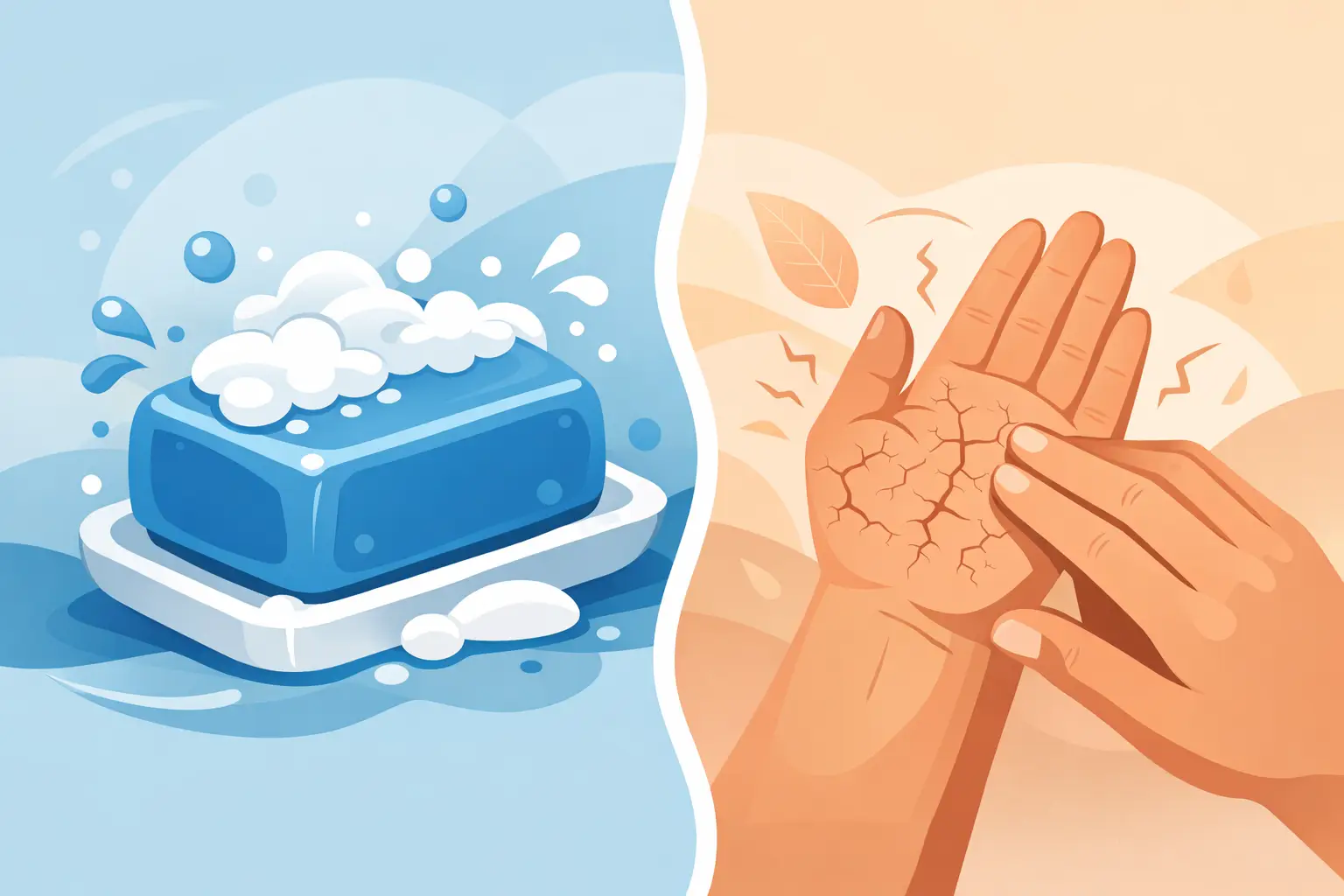
Eczema is a barrier problem as much as it is an inflammation problem. When the barrier is compromised, water escapes more easily and irritants get in more easily. Cleansing that strips oils, disrupts the skin’s surface, or leaves residues you react to can keep that cycle going.
A well-made tallow soap may help because it cleans without that squeaky, over-stripped feeling – and because many people find it leaves skin feeling comfortable rather than tight. The trade-off is that true soap is still an alkaline cleanser, and for a minority of eczema sufferers that alone can be enough to irritate.
Why eczema-prone skin reacts to “normal” cleansers
Many mainstream washes are built around strong surfactants designed to lift oil and grime fast. That is great for a kitchen floor. It is not always great for skin that already struggles to hold onto moisture.
Eczema-prone skin tends to react to three broad problems: harsh detergents, fragrance and essential oils, and over-cleansing (too hot, too often, too long). Even a “natural” cleanser can tick those boxes.
Bar soaps also have a reputation problem because older, heavily stripped formulas could leave skin feeling tight. The more modern reality is that artisan soapmakers can create bars that feel very different on the skin – denser, creamier, with a gentler glide and a more comfortable after-feel.
What tallow brings to a soap bar
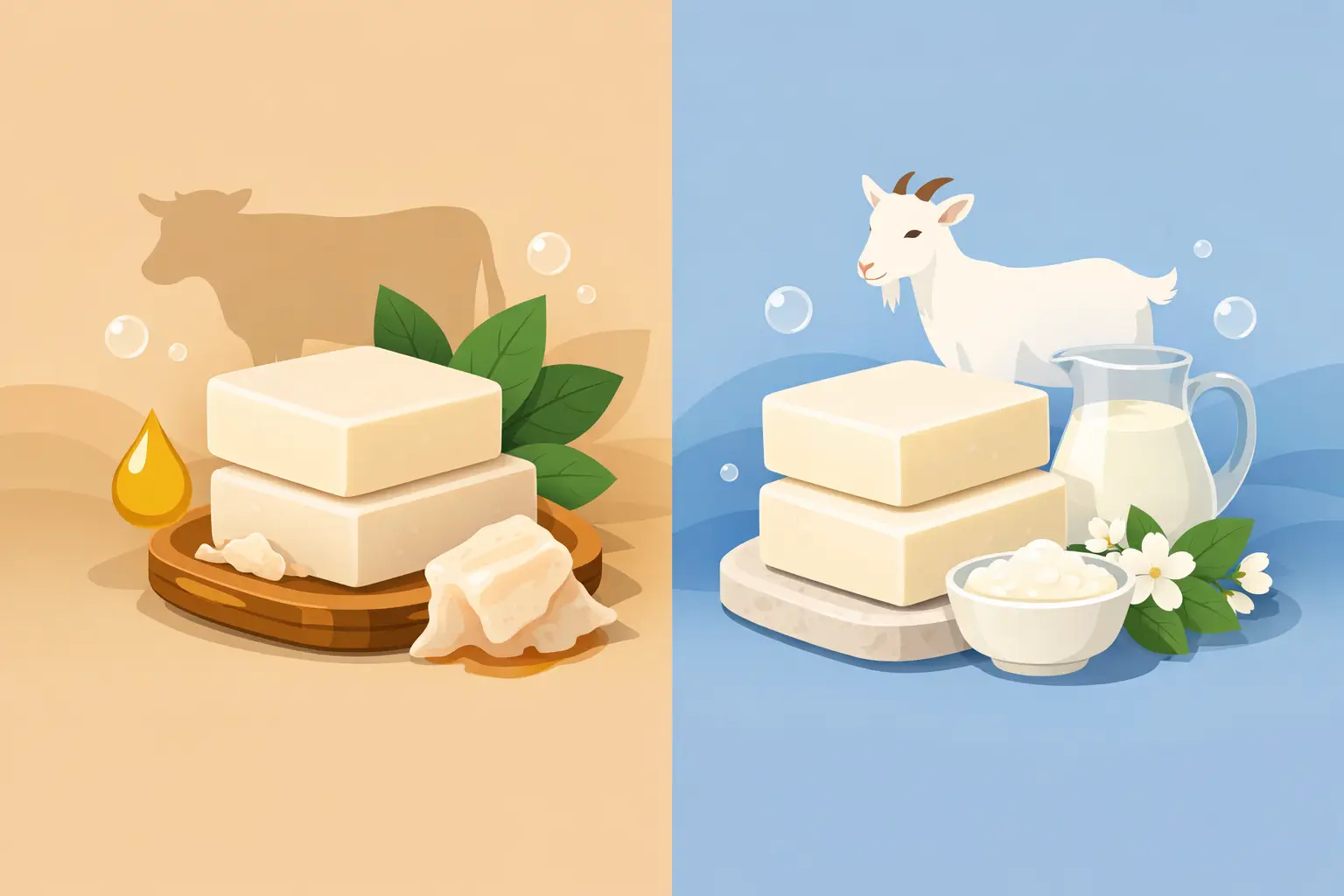
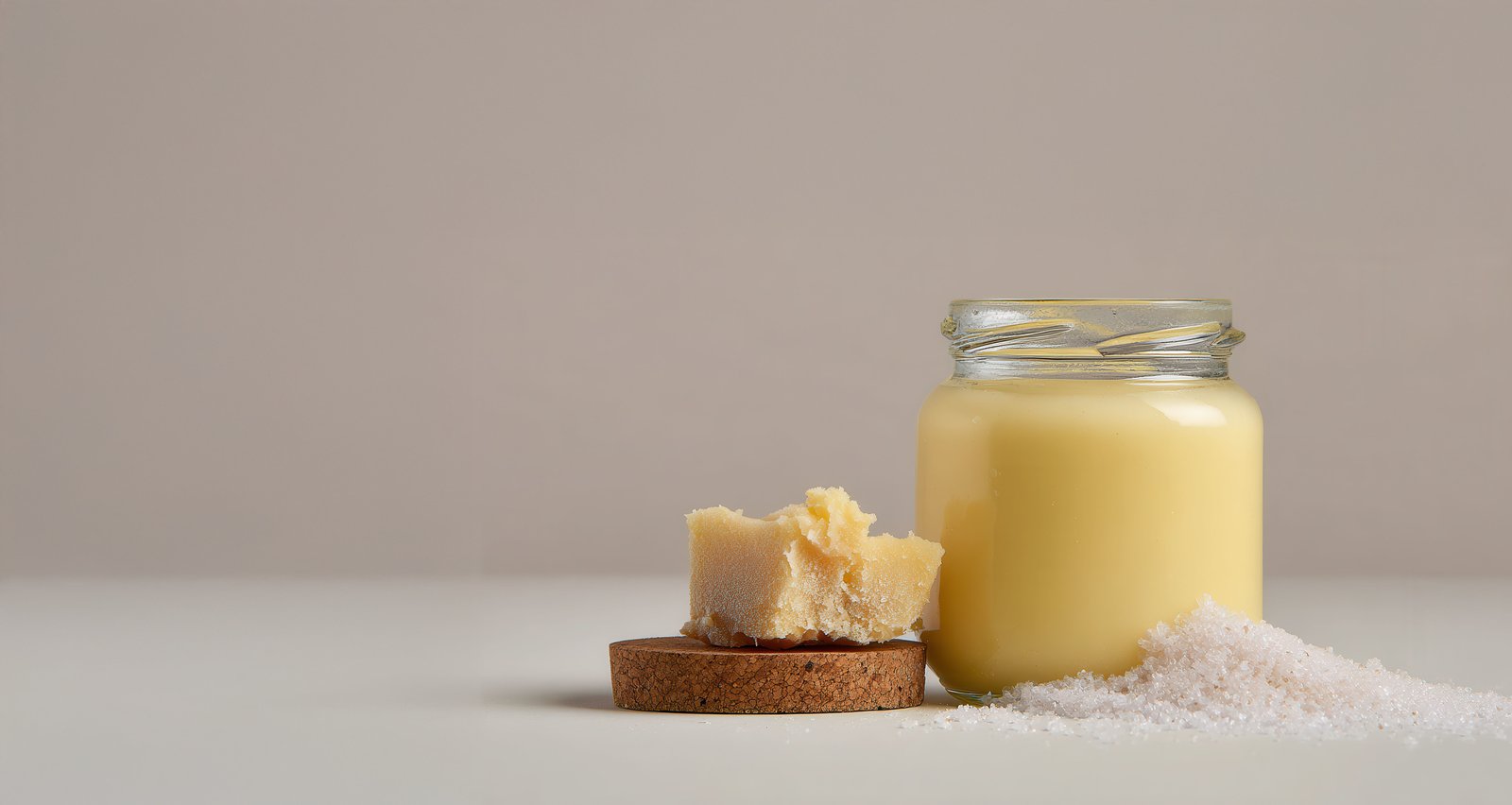
Tallow is rendered animal fat, traditionally used in soapmaking long before liquid body washes were a thing. When it is properly purified and used in a balanced recipe, it contributes a firm bar, a rich lather and a conditioning feel.
From a skin-comfort point of view, tallow contributes fatty acids that many people with dry skin find supportive, particularly oleic and stearic acids. These are the kinds of building blocks that help skin feel supple rather than papery.
You will often hear talk of tallow being “similar to our skin”. The important, practical meaning of that claim is this: tallow-based soaps can feel less alien on the skin than bars made with only highly cleansing oils. That does not make it a medical treatment for eczema, but it can make daily washing less of a battle.
Quality matters. Slow-rendered, well-filtered tallow has a clean profile. Poorly rendered tallow can carry odour or impurities that nobody wants on sensitive skin.
Soap is soap: the pH question (and why it doesn’t always mean “no”)
True soap is made by saponification – fats reacting with an alkali. The finished bar is usually alkaline. Eczema-prone skin often prefers minimal disruption, and in an ideal world you would never nudge the skin away from its slightly acidic surface.
So does that automatically rule out tallow soap for eczema? Not necessarily. Many people tolerate an alkaline bar perfectly well if the formula is gentle and they moisturise promptly afterwards. Others flare quickly. This is why the best answer is honest: it depends.
If your eczema is active, cracked, weeping or infected, even water can sting. In those moments, a leave-on emollient routine and medical guidance matter more than switching soaps.
What to look for in a tallow soap if you have eczema
If you are considering a tallow bar, look beyond the headline ingredient.
First, choose a simple formula. The fewer extras, the fewer opportunities for irritation. A bar without fragrance or with a very light scent is often the easier starting point.
Second, watch essential oils. “Natural” does not automatically mean “non-reactive”. Peppermint, citrus, cinnamon, clove and many floral oils can be troublesome for eczema-prone skin. Some people do brilliantly with them. Many do not.
Third, pay attention to superfat and balance. In artisan soapmaking, a bar can be formulated to leave a little of the oils unsaponified, which can feel more cushioning on dry skin. A well-balanced bar should cleanse without leaving that tight, squeaky finish.
Fourth, consider oat and milk additions carefully. Oatmeal is often soothing for eczema, but a scratchy, exfoliating bar can be the wrong choice during a flare. Goat milk can feel comforting for some, but again – it is about the whole formula and your own skin.
Finally, packaging and freshness matter. A properly cured bar lasts longer and behaves more predictably. Overly soft bars can dissolve quickly, leaving residue and encouraging overuse.
How to use tallow soap more safely on eczema-prone skin
Technique matters as much as ingredients.
Keep showers short and lukewarm. Hot water is a reliable eczema trigger because it strips lipids and increases transepidermal water loss.
Use the bar on the “need it” areas first: underarms, feet, hands. Many eczema sufferers do better when they avoid soaping large patches of very dry skin every single day.
Lather in your hands or on a soft cloth rather than rubbing the bar directly on irritated areas. Less friction, fewer problems.
Rinse thoroughly. Leftover cleanser can irritate.
Then moisturise immediately – within a couple of minutes. This is not a nice-to-have. It is the point where you help the barrier recover after contact with water.
Patch testing: the quiet step that saves a lot of grief
Eczema skin can be unpredictable. Patch testing is a simple way to learn without committing your whole body.
Try the soap on a small area for a few days in a row – the inner forearm often works. If you notice heat, stinging, itching that lingers, or a spreading rash, stop. If everything stays calm, you can expand use gradually.
If you are patch testing a scented bar, be extra cautious. Sometimes it is not the soap base that causes trouble – it is the fragrance component.
When tallow soap is not a good idea
There are clear situations where you should be cautious or choose an alternative.
If your eczema is severely flared, cracked or weeping, cleansing should be as non-irritating as possible and guided by what your clinician recommends. A soap bar – any soap bar – can feel like too much.
If you know you react to fragrance, do not gamble with a heavily scented “natural” bar. Start fragrance-free.
If you are prone to contact dermatitis, you may react to specific botanicals, resins or essential oils even at low levels.
And if your eczema is primarily on the face, be more conservative. Facial skin tends to be less forgiving than body skin.
The sustainability angle (because it matters here)
Many eczema sufferers are also ingredient readers and low-waste shoppers. A well-made bar can be a satisfying swap: no plastic bottle, less water shipped around, and a product that lasts.
Tallow, when sourced responsibly, can also fit a circular mindset. It uses a nutrient-rich ingredient that might otherwise be wasted, and it pairs naturally with small-batch, traditional manufacturing.
If ethical sourcing matters to you, ask where the tallow comes from and how it is rendered. Transparency is not a marketing extra. It is part of the product.
Choosing a bar with confidence
If you are looking for a tallow-based bar crafted with sensitive skin in mind, Luna Natural Soap Co. shares detailed sourcing and process notes alongside its small-batch approach at https://Www.lunasoap.ie.
The bigger point is this: the “right” soap is the one that lets you wash without paying for it later. Comfortable skin after cleansing is a result, not a promise.
Eczema is personal. Your triggers might be detergents, fragrance, hard water, stress, pollen, certain fabrics, or all of the above. A thoughtfully formulated tallow soap can be a calm, practical part of your routine, but it should never be the only support you rely on.
If you take one thing into the bathroom next time, let it be this: wash like you are protecting your skin barrier, not trying to defeat your skin. The difference shows up quietly – in fewer tight moments, fewer scratchy evenings, and a little more peace in the everyday.