


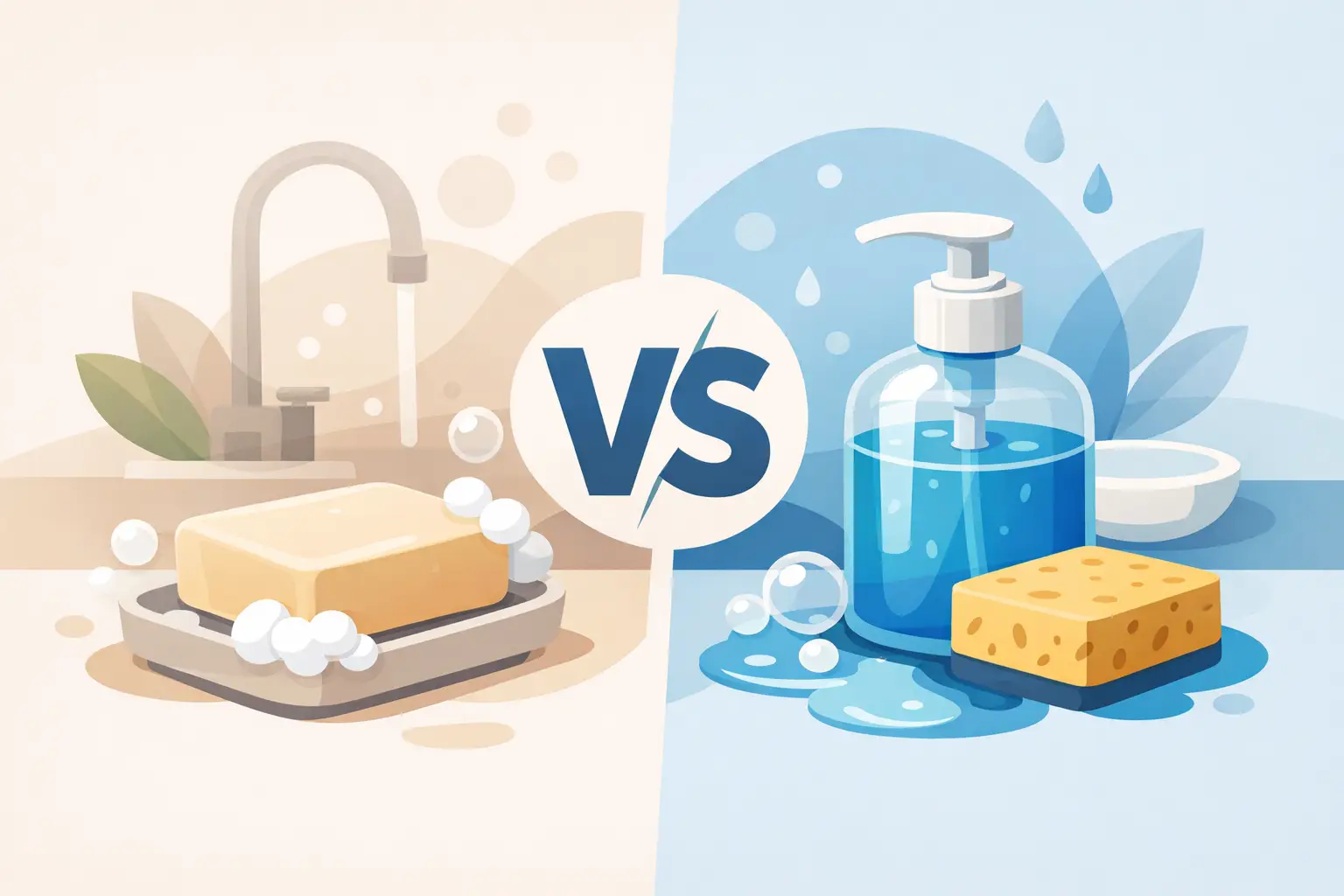
You notice it most at the kitchen sink. A plastic bottle empties faster than expected, the pump clogs with dried soap, and another container heads for the bin. That is usually when the question shifts from habit to choice: kitchen soap bar versus liquid. Which one actually works better, feels better to use, and makes more sense for a home that cares about ingredients and waste?
The honest answer is not as tidy as bar good, liquid bad. Both can wash dishes well. Both can cut grease when they are properly made. But they do not perform in quite the same way, and they carry very different trade-offs around packaging, formulation, cost and everyday use. If you are trying to build a lower-waste kitchen without making life harder, the details matter.
Kitchen soap bar versus liquid: the real difference
At the simplest level, liquid washing-up soap is water-heavy and pump-dispensed, while a solid dish soap bar is concentrated and used with a brush, cloth or sponge. That sounds like a small distinction. In practice, it affects almost everything.
Liquid soap is familiar. It is easy to dose, quick to spread, and simple for guests or children to understand. For many households, that convenience is the main reason it stays by the sink. The downside is that you are often paying for a formula diluted with water, packaged in plastic, and shipped in a heavier container than necessary.
A kitchen soap bar strips that back. Because it is solid, it tends to be more concentrated. There is no pump to break and usually far less packaging. A well-made bar can feel surprisingly luxurious too – firm in the hand, rich in lather, and clean-rinsing rather than slimy. But it does ask for a small shift in routine. You do not squirt it straight on to a pan. You load your brush or cloth from the bar, then wash.
That change is minor for some people and mildly irritating for others. Whether it feels like an upgrade or a faff depends on how you use your kitchen.
Cleaning power: does a bar actually cut grease?
This is usually the first concern, and fairly so. No one wants an eco swap that leaves plates cloudy and frying pans greasy.
A good solid dish soap bar can cut through grease very well. The key phrase is good. Not every bar sold for household use is equal, and not every body soap should be used on dishes. A proper kitchen bar is formulated for cleaning cookware and crockery, not for moisturising skin first and foremost.
Because solid soap is concentrated, it can produce a dense, effective lather when used with a brush or sponge. On everyday washing-up – plates, glasses, lunch boxes, cutlery – it often performs every bit as well as liquid. It can be especially satisfying on baked-on residue when paired with a sturdy dish brush.
Where liquid can feel easier is speed. If you are tackling a huge pile of greasy roasting trays, squeezing liquid directly into hot water may seem faster. That is not always because it cleans better. It is often because it spreads instantly. For some households, especially larger families cooking heavily every day, that convenience still counts.
So if your question is performance, the answer is this: a kitchen soap bar can absolutely do the job, but the user experience is slightly different.
Ingredients matter more than most people think
For many people, the real decision is not only about dishes. It is about hands.
Kitchen work means repeated washing. If your soap leaves your skin tight, red or sore, the problem is not trivial. Liquid washing-up products often rely on stronger surfactants, synthetic fragrance, preservatives and dyes. Some are perfectly manageable for robust skin. Others are harsh enough to make dry or sensitive hands worse over time.
A thoughtfully made solid dish soap can be a gentler option, especially if it avoids unnecessary fillers and overpowering fragrance. That does not mean every bar will suit every person, and it does not mean all natural formulas are automatically mild. But simpler formulations often give customers more clarity about what they are actually using several times a day.
This is where traditional soapmaking still has real value. When ingredients are chosen with care and the formula is made to cleanse effectively without feeling aggressive, the difference shows up in daily use. Hands feel clean, not stripped. That matters in a busy home.
Waste, packaging and the bigger footprint
If sustainability is part of the reason you are comparing kitchen soap bar versus liquid, bars usually come out ahead.
Most liquid dish soaps are sold in plastic bottles, sometimes recyclable, sometimes not widely recycled in practice. Even refill systems still depend on plastic somewhere in the chain. A solid bar, by contrast, is often packaged in cardboard or paper and can be sold with little to no plastic at all.
There is also the matter of transport. Shipping water around is less efficient than shipping a concentrated solid. One compact bar usually takes up less space and weighs less than multiple liquid bottles needed for the same number of washes.
Of course, sustainability is not just packaging. It includes sourcing, production methods and how long a product lasts in real life. A poorly made bar that goes mushy in a week is not a smart low-waste choice. A firm, long-lasting bar stored properly on a draining dish is.
That is why craftsmanship matters. A solid soap should hold its shape, lather well and wear down steadily rather than dissolving into paste beside the sink.
Cost per wash: cheaper or just marketed that way?
At first glance, liquid can look cheaper, especially when sold in large bottles or supermarket promotions. But shelf price is only part of the story.
Because liquid soap contains a significant amount of water, you may use more than you realise. A generous squeeze becomes the habit. A pump or capful here and there adds up quickly. Solid bars tend to encourage more controlled use. You load what you need on to your brush, and that is often less than you would pour from a bottle.
In many households, a kitchen bar lasts longer than expected. Not always. Usage habits, water hardness and storage all affect lifespan. But cost per wash is often better than the sticker price suggests.
The fairest way to judge value is to watch one full product cycle. How long does the bottle last in your kitchen? How long does the bar last under the same conditions? Once you compare that, the economics become clearer.
Ease of use in a real kitchen
This is where preferences become personal.
Liquid soap wins on instant familiarity. It is straightforward for shared homes, quick for fast clean-ups and easy to keep beside the sink. If your household includes people who resist any change to routine, liquid is the path of least resistance.
A soap bar asks for a small setup. You need a draining tray or dish. A brush tends to work better than a flat sponge, though either can be used. If the bar sits in pooled water, it will not last as it should. Once that system is in place, many people find it just as easy.
There are also cases where a mixed approach makes sense. Some households keep a solid dish soap for daily washing-up and a liquid product for occasional heavy degreasing or quick hand-washing at the sink. Purity is not the goal. A practical kitchen is.
Who should choose a kitchen soap bar?
If you care about reducing plastic, prefer simpler ingredient lists and do not mind changing a small habit, a solid dish soap bar is usually the stronger choice. It suits people who value concentration over convenience theatre and want household products that feel purposeful, not disposable.
It can be especially appealing if you already choose traditional soaps for bath or shower and want the kitchen to follow the same standards – fewer unnecessary additives, less waste, and products made with care rather than speed.
For households with very high-volume washing-up, or for anyone who knows they will not maintain a soap dish properly, liquid may still be the better fit. There is no virtue in buying a bar that will be left soaking by the tap and quietly abandoned after a week.
Luna Natural Soap Co. sees this often: people do not need more products, they need better-made ones that suit real routines.
So, which wins?
If the measure is pure convenience, liquid still has an edge. If the measure is concentration, lower waste and a more thoughtful ingredient profile, the bar is hard to beat.
The better question is not which format is universally superior. It is which one fits the kind of home you are trying to build. A kitchen soap bar makes sense when you want everyday function with less plastic, less clutter and more intention. And once that becomes your normal, the bottle often starts to feel like the compromise.