

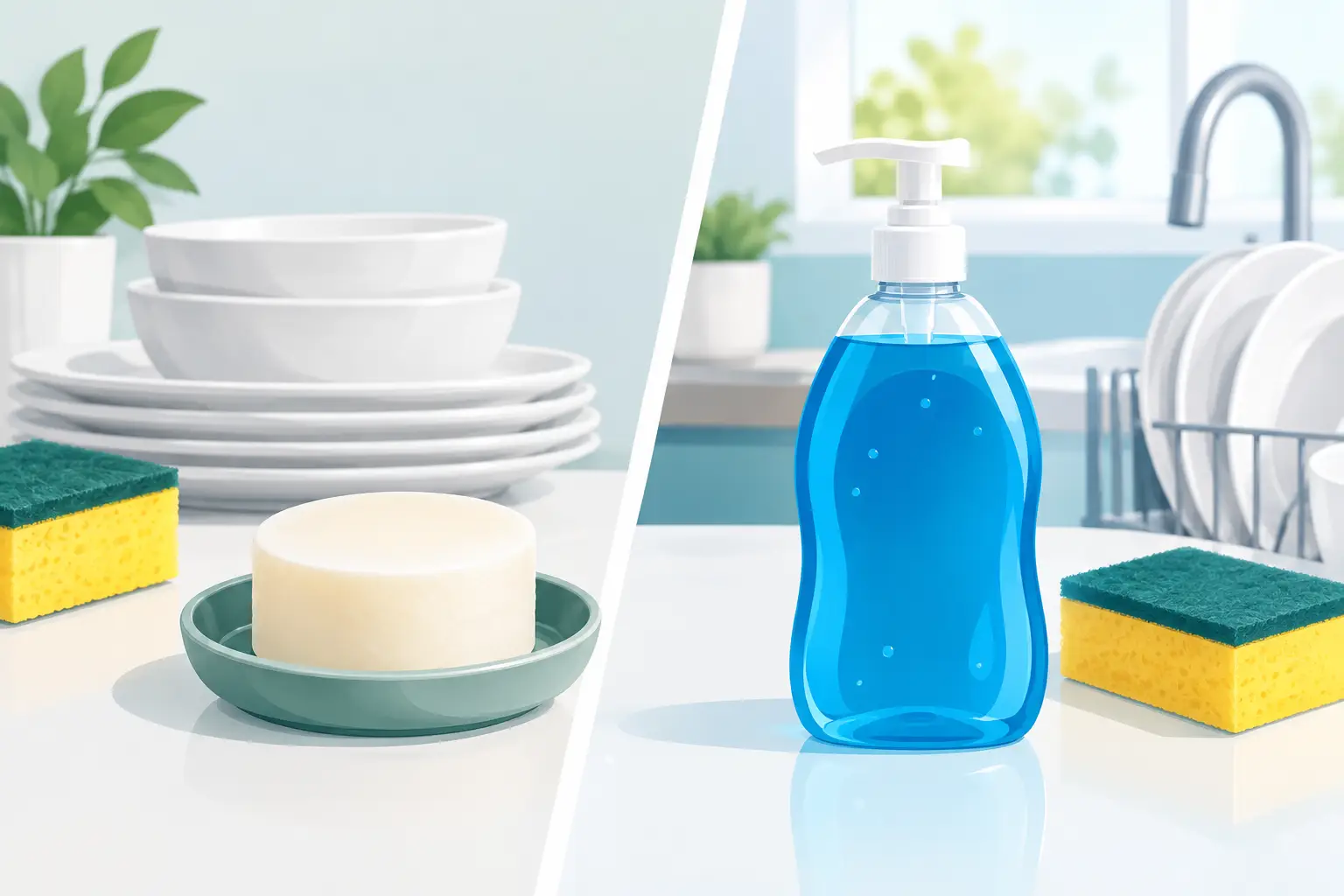
The bottle is nearly empty again, the sink is full, and the question is more practical than it first appears: solid dish soap versus liquid – which one genuinely earns its place beside the kitchen sink? For households trying to reduce plastic without settling for poor results, the answer comes down to more than format. It is about ingredients, washing habits, water hardness and how a product feels to use every day.
A well-made solid dish soap can cut through a greasy roasting tin, create a rich lather and last far longer than many expect. Liquid washing-up products remain convenient, especially for certain tasks. Neither format is automatically better in every home. The useful comparison is an honest one.
What is the real difference between solid dish soap and liquid?
Liquid washing-up products are typically made with water, surfactants, preservatives, fragrance and other ingredients that keep the formula stable and easy to pour. Some are thoughtfully formulated; others rely on strong detergents, heavy perfume or unnecessary dyes.
A solid dish soap is a concentrated bar. Traditional soap is made by combining oils or fats with an alkali, creating the cleansing salts we know as soap. Because a bar contains very little water, it does not need a plastic bottle or the same preservation system as a water-based liquid product.
That concentration matters. A firm bar is not simply liquid soap without the bottle. It is a different way of washing up: you wet a brush, cloth or sponge, work it over the bar, then wash as normal. The bar stays by the sink on a draining dish, ready for the next load.
For Luna Natural Soap Co., the approach is rooted in traditional soapmaking. Its solid tallow dish soap is made in small batches using slowly rendered, locally sourced tallow – an ingredient that would otherwise be overlooked. It is practical circularity: a hardworking household bar made from a valuable natural material, wrapped without the throwaway plastic.
Solid dish soap versus liquid: cleaning performance
The concern most people have is simple: will a bar shift grease? A good solid dish soap should. Soap molecules are drawn to both water and oil, helping lift cooking fats and food residue from plates, pans and utensils so they can be rinsed away.
For everyday washing up, a solid bar performs particularly well on glasses, plates, cutlery, mugs, lunchboxes and lightly greasy pans. A washing-up brush with firm bristles helps create an effective lather and gets into the corners of baking dishes or reusable food containers.
Liquid can have an advantage when you want to squirt product directly onto a stubbornly greasy tray or when you are washing a large quantity of items at speed. If you are used to filling a bowl with heavily fragranced bubbles, a solid bar may feel different at first. Less foam does not necessarily mean less cleaning power, but the technique is not identical.
For baked-on residue, start with hot water and a soak. This is usually more effective, and kinder to your cookware, than adding more cleanser of any kind. Then use a brush or scrubber with the solid soap. Very burnt pans may still need time, elbow grease or a purpose-made scourer. No gentle dish product can make carbonised food vanish instantly.
A note on hard water
Water hardness can change the experience of any true soap bar. In hard-water areas, soap may form a little residue or require more rinsing, particularly on glassware. This is not a fault in the bar; it is the natural reaction between soap and minerals in the water.
If your water is very hard, use a little less product, rinse in warm running water and allow the bar to dry properly between uses. A liquid detergent formulated specifically for hard water may suit some households better. The most sustainable choice is the one you will use consistently and enjoy using.
Ingredients matter as much as format
Plastic-free packaging is meaningful, but it should not distract from what is inside. A solid dish bar can still contain ingredients that do not suit your preferences, just as a liquid can be responsibly made. Read the ingredient list and look for clarity rather than vague claims.
Traditional soap bars are often appealing to people who prefer straightforward formulations. Tallow is valued in traditional soapmaking for creating a hard, long-lasting bar with a stable, creamy lather. When it is sourced from local, regenerative-minded farms and rendered in-house, it also supports a more transparent relationship with the materials used.
For people whose hands become dry or uncomfortable after repeated washing up, a simpler soap can feel like a welcome change from strongly perfumed detergents. Still, washing dishes is a cleansing task, not a skincare treatment. Hot water, frequent wetting and scrubbing can irritate even resilient hands. Choose a formula you tolerate well, wear gloves for heavier jobs, and follow with a nourishing hand balm if your skin is dry or eczema-prone.
Fragrance deserves consideration, too. A fresh scent can make the kitchen feel pleasant, but it is not proof of cleanliness. If your hands are sensitive, you may prefer an unscented or lightly scented option and avoid products with a long list of unnecessary additives.
Waste, packaging and the products you bring home
A bottle of washing-up liquid is mostly water transported in plastic. Even when that bottle is recyclable, recycling depends on local facilities, correct sorting and whether the material is recovered at all. Refills can reduce packaging, but they still often rely on plastic pouches, bottles or delivery containers.
A solid bar removes much of that packaging burden from the start. It is compact, light and can be wrapped in paper or sold without packaging. It also avoids the familiar half-empty bottle that cannot be used without adding water, shaking vigorously and hoping for another few washes.
There is a practical waste consideration, however: a bar that sits in a puddle will dissolve quickly. Give it a raised draining dish or holder, rather than leaving it in the bottom of the sink. This small habit protects the bar and keeps the sink area tidier.
The environmental picture also depends on what you use alongside it. A solid dish soap paired with a disposable plastic sponge replaced every week is still a better step away from single-use bottles, but a durable brush with replaceable head, natural fibre scourer or washable cloth can reduce waste further.
Which option offers better value?
Comparing shelf prices can be misleading. A bar may look more expensive than a bottle, yet it is highly concentrated and only a small amount is needed each time. The true measure is cost per wash, not cost at the till.
A solid bar lasts best when the brush is damp rather than dripping wet, and when the bar can dry after use. Load the brush with soap, wash several items, then return for more only when needed. You do not need to rub the brush over the bar before every plate.
Liquid is easy to over-pour. A generous squeeze feels satisfying, but it can mean sending more product down the drain than the washing up requires. Pump dispensers can help control portions, while a solid bar naturally encourages a more measured approach.
If a bar lasts four to eight weeks in one home and only two in another, neither household is doing anything wrong. The difference may be family size, cooking habits, water temperature, the type of brush used and whether the bar is stored dry. Value is personal, but concentrated products often reward thoughtful use.
When liquid dish soap may still be the better choice
A solid bar is not a purity test. Liquid may be the more convenient option for a shared kitchen, a workplace sink or anyone with limited hand strength who finds a pump easier to manage. It can also suit homes with exceptionally hard water, depending on the formula.
If you are making the swap for the first time, there is no need to throw away a partly used bottle. Finish what you have, then try a solid bar for everyday dishes. Notice how it performs with your own water, cookware and routine. A considered change is more likely to last than an all-or-nothing one.
How to make a solid dish bar work beautifully
The method is simple, but a few details make a noticeable difference. Wet your dish brush, cloth or sponge, then rub it across the bar until lightly coated. Wash your items in warm water, rinsing as you go. For a full bowl, you can agitate the soapy brush in the water to build a gentle lather.
Keep the bar on a draining soap dish between uses. Do not leave it submerged, and avoid storing it in a sealed container while wet. For pans with stuck-on food, soak first and use the brush directly on the problem area.
The best kitchen essentials are the ones that quietly make daily work feel better. Whether you choose solid dish soap or liquid, look for honest ingredients, effective cleaning and less needless waste – then let your sink-side routine become one small, satisfying act of care.