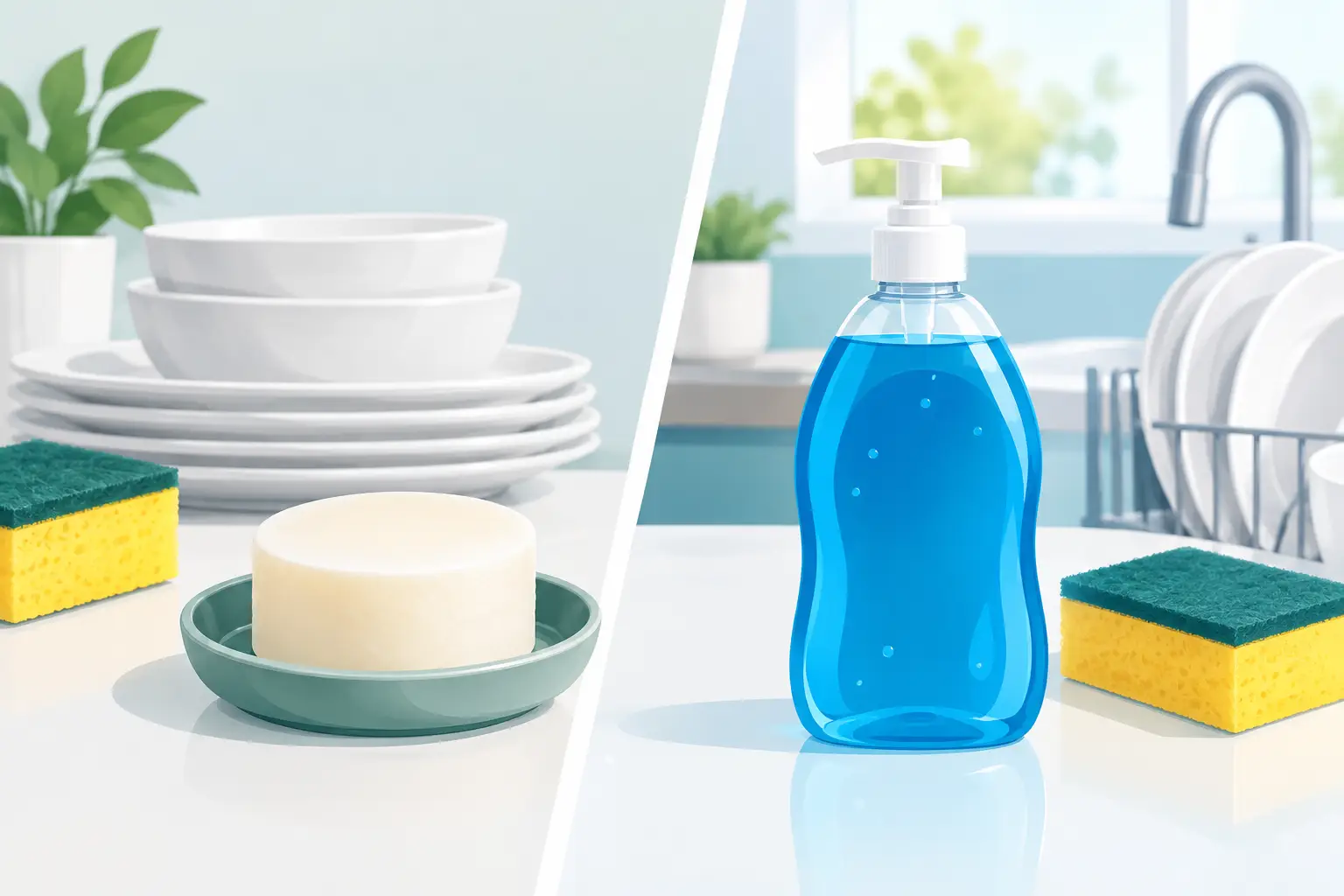



The washing-up liquid by the sink looks ordinary enough – until you start noticing how quickly the bottle empties, how often your hands feel tight afterwards, and how much plastic builds up over a year. That is usually the point where solid dish soap vs liquid detergent stops being a passing thought and becomes a real household decision.
For many homes, both options can get plates clean. The difference lies in how they clean, what they leave behind on your skin, and what they ask of your routine. If you care about ingredients, waste, and choosing products that feel as good in practice as they do in principle, it is worth looking a little closer.
Solid dish soap vs liquid detergent: what actually changes?
At a glance, the biggest difference is format. One comes as a concentrated bar, usually used with a brush, cloth or sponge. The other is pre-diluted in a bottle and squeezed directly into water or onto a sponge. But the format shapes almost everything else – from packaging and longevity to ingredient choices and how easy it is to control the amount you use.
Solid dish soap tends to be simpler by nature. Because it does not need to sit in a bottle as a pourable liquid, it often requires fewer stabilisers and less water in the formula. That can appeal to shoppers who prefer straightforward, purposeful ingredients and less unnecessary packaging.
Liquid detergent is familiar, convenient and quick. For busy kitchens, that ease matters. A squeeze into hot water and you are ready to go. If you are washing heavily greased pans after a roast dinner, or if several people in the house are doing the washing up and need something foolproof, liquid can feel more immediate.
Neither option is universally better in every kitchen. The right choice depends on what you value most.
Cleaning power is not just about bubbles
There is a long-standing habit of judging a washing-up product by the amount of foam it makes. More bubbles can feel reassuring, but foam is not the same as cleaning performance.
A well-made solid dish soap can cut through grease effectively because it is concentrated. You are loading your brush or sponge directly from the bar, rather than adding a watered-down product. That can make it surprisingly capable on everyday dishes, glasses, cutlery and pans with light to moderate grease.
Liquid detergent often has the edge when speed is the priority or when you are dealing with very heavy, repeated grease. Because it disperses instantly in water, it suits larger sinkfuls and high-volume washing up. In some cases, especially after frying or baking with oil-rich foods, it may feel faster.
That said, a lot comes down to technique. Hot water, a good washing-up brush and not overloading the sink all matter. If someone tries a solid soap bar as though it were a direct one-pump replacement for liquid, it can feel unfamiliar at first. Once the routine settles, many people find the cleaning power more than enough for daily use.
Where solid dish soap often shines
Solid dish soap tends to work particularly well for smaller, steadier washing-up loads. A few breakfast bowls, mugs, lunch containers and cooking utensils are where it feels efficient and tidy. There is less product waste, and you can use exactly what you need.
It also suits households that prefer intentional choices over disposable convenience. A firm bar and a rich lather can feel surprisingly satisfying when the product is made to last.
The skin question matters more than most people think
If you wash up once a day, perhaps any detergent will do. If you wash your hands repeatedly, deal with dry skin, or already know that harsh cleansers leave your knuckles sore, the formula matters.
Many liquid detergents are designed first around degreasing strength. That can be useful on cookware, but repeated exposure can strip the skin’s natural oils. The result is often that familiar tightness after washing up, especially in colder months.
Solid dish soap is not automatically gentle simply because it is solid. The ingredient quality and method of making still matter. But bars made with traditional soapmaking methods and nourishing fats can feel less aggressive on the hands than some highly detergent-heavy liquids. For people already trying to reduce irritants around the home, that difference can be meaningful.
This is one reason some households move towards a solid tallow dish soap. Tallow is a traditional ingredient with a long history in soapmaking, valued for creating a hard, long-lasting bar with a creamy lather. In a well-formulated dish soap, it can support a cleansing experience that feels effective without making the whole task feel punishing on the skin.
Of course, if you have very sensitive skin, gloves may still be sensible for long washing-up sessions. Gentler does not always mean glove-free, particularly with baked-on grease and hot water involved.
Packaging, waste and what you bring into the home
For eco-minded shoppers, the packaging difference is often what prompts the switch.
Liquid detergent usually comes in plastic bottles. Even when recyclable, they still need to be produced, transported and processed. Over time, one small household can get through a surprising number.
Solid dish soap is typically sold with minimal or plastic-free packaging. That makes it a practical low-waste swap rather than a symbolic one. You are not just buying a different cleanser. You are reducing repeat packaging at source.
There is also the transport question. A solid bar is lighter in packaging terms because it is not bulked out with as much water. While no product is impact-free, concentrated formats tend to make more sense for shoppers trying to cut everyday waste.
For a brand built around careful sourcing, traditional methods and circular thinking, that matters. A household product should work hard, but it should also sit comfortably with the values of the home it is in.
Cost per use can tell a different story
Liquid detergent can look cheaper on the shelf. That is partly because we are used to seeing it in larger bottles at a familiar price point. But cost per use is where solid bars often become more persuasive.
A solid dish soap bar is concentrated and usually lasts far longer than people expect, particularly if it is allowed to dry properly between uses. If you keep it on a draining dish or soap rest, rather than sitting in a puddle, you get much better value from it.
Liquid detergent is easier to overuse. A generous squeeze becomes a habit. With a bar, the dose is more controlled by design. You load your brush, use what you need, and stop.
That does not mean solid is always cheaper in every case. In a very large household doing frequent, heavy-duty washing up, a budget liquid may still come out ahead on raw cost. But if you compare like for like – quality ingredients, durability and packaging – solid dish soap often holds its ground well.
Convenience is where most people hesitate
This is usually the deciding factor.
Liquid detergent wins on familiarity. Guests know what to do with it. Teenagers do not need instructions. It fits the rhythm most of us grew up with.
Solid dish soap asks for a small shift. You rub a damp brush or sponge over the bar, build lather, wash, then repeat as needed. For some people, that becomes second nature within days. For others, especially if they want to fill a whole sink with suds in one go, it can feel less intuitive.
If your kitchen routine is rushed and you want maximum speed with minimum thought, liquid may still suit you better. If you do not mind a slightly more hands-on process in exchange for less waste and a more considered formula, solid starts to look like the stronger choice.
A fair way to decide
Ask what frustrates you about your current washing-up liquid. If it is the plastic, the drying effect on your hands, or how quickly it runs out, a solid bar directly answers those concerns. If your only priority is speed and habit, liquid probably keeps its place.
That is why the best answer is not ideological. It is practical. Some households even keep both – a solid bar for daily dishes and a liquid detergent for occasional heavy grease or very large clean-ups.
Which option fits your kitchen best?
When people compare solid dish soap vs liquid detergent, they are rarely comparing cleanser alone. They are comparing two ways of running a home. One is built around convenience and convention. The other leans towards concentration, lower waste and a more traditional approach to cleaning.
If you want a product that feels aligned with natural living, thoughtful ingredients and plastic-free habits, solid dish soap is an easy switch with real daily impact. If you need the quickest route through a full sink of greasy pans after Sunday lunch, liquid may still earn its keep.
The most useful home swaps are the ones that work quietly in the background. Choose the one you will actually enjoy using, because the best sustainable habit is usually the one that feels simple enough to keep.