

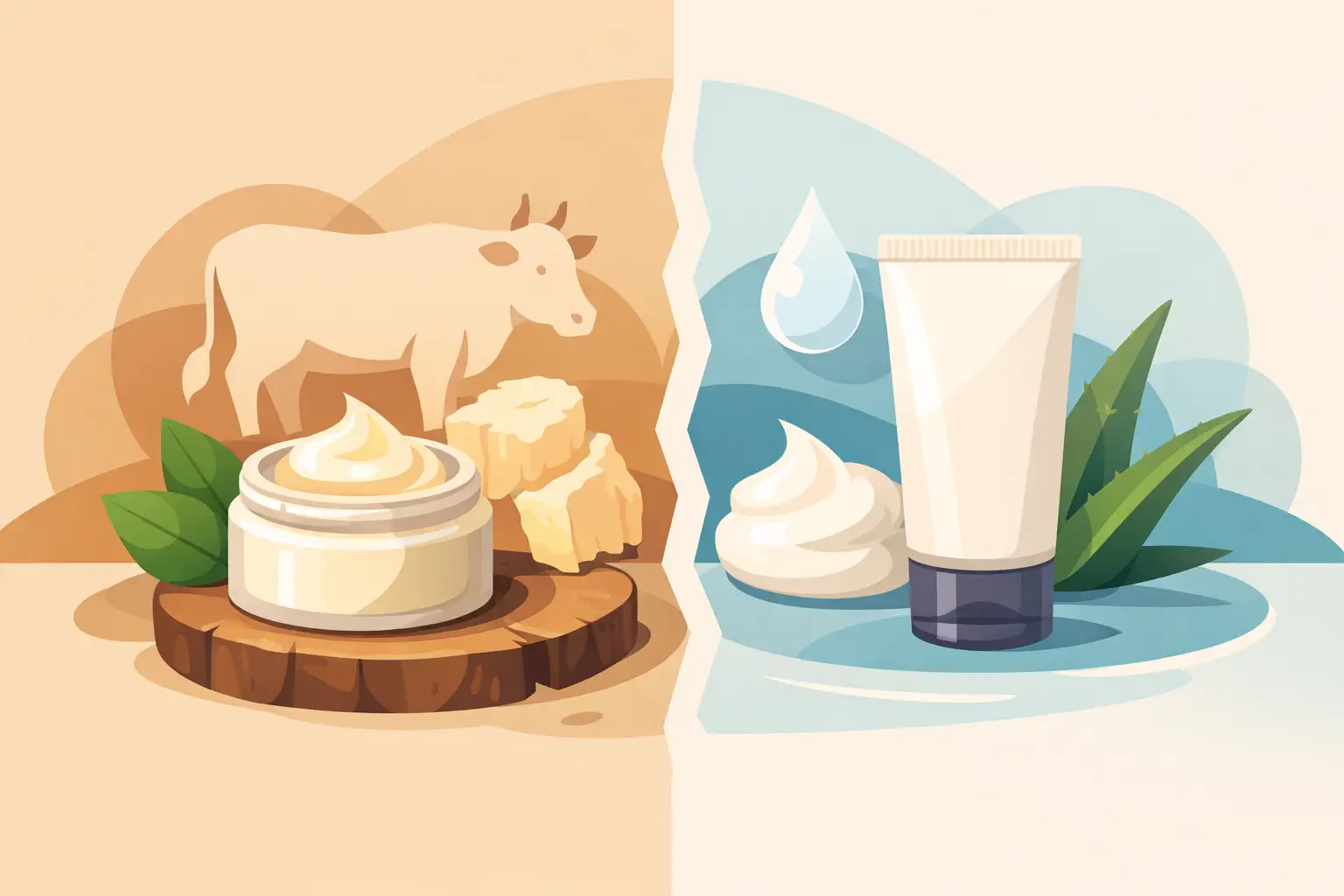
If your skin still feels tight half an hour after moisturising, the label may be promising more than the formula delivers. That is often where the question starts – tallow balm or moisturiser?
For dry, sensitive or easily irritated skin, the difference is not just texture. It is about how a product is built, how much water it contains, and whether it helps your skin stay comfortable once the first fresh layer has worn off. Some people do beautifully with a classic moisturiser. Others find that a simple tallow balm gives longer-lasting relief with fewer variables to react to.
Tallow balm vs moisturiser: what is the real difference?
At the simplest level, a moisturiser is usually a water-based formula. It often contains water, oils, humectants such as glycerine, emulsifiers to hold everything together, and preservatives to keep it stable. This can feel light, silky and easy to spread. For many people, that texture is appealing.
A tallow balm is different. It is typically anhydrous, which means water-free. Instead of being built around water, it is built around fats and oils, with tallow as the star ingredient. A well-made tallow balm is rich, concentrated and designed to support the skin barrier by sealing in moisture and softening rough, dry areas.
That distinction matters. Water-based moisturisers can give an immediate feeling of hydration, but they often rely on a blend of ingredients to stop the formula separating and spoiling. A tallow balm tends to be simpler and more concentrated. For skin that is reactive, stripped or persistently dry, fewer ingredients can be a practical advantage.
Why some skin prefers tallow
Tallow has been used on skin for generations, long before skincare became crowded with clever names and long ingredient lists. There is a reason it has endured. Properly rendered tallow is naturally rich in fatty acids and contains vitamins A, D, E and K. More importantly, it is deeply compatible with the skin.
Human skin needs lipids to stay strong and comfortable. When that barrier is compromised, skin can feel rough, flaky, sore or prone to irritation. Tallow works well here because its composition is close to the oils that help protect our skin naturally. That does not mean it is a miracle ingredient. It does mean it often makes sense, especially when your skin is asking for calm rather than novelty.
For people dealing with dry patches, winter skin, over-cleansing or eczema-prone areas, a tallow balm can feel more substantial than a standard moisturiser. It sits on the skin differently. It cushions. It softens. It helps reduce that constant cycle of applying cream, feeling relief for a moment, then needing more.
Where a moisturiser may make more sense
This is where nuance matters. Not every moisturiser is poor, and not every person needs a balm.
If your skin is balanced, slightly dry or you prefer a lighter daytime product under make-up, a moisturiser may suit you better. Water-based creams can feel more breathable and less noticeable on the skin. In warmer weather, or for those who dislike a richer finish, that can be a genuine benefit.
Some moisturisers also combine humectants and emollients very effectively. A thoughtful formula can pull moisture into the upper layers of the skin while softening the surface. If your skin tolerates a wider range of ingredients, and you enjoy that lighter cosmetic feel, there is nothing wrong with choosing one.
The trade-off is often longevity. A lighter moisturiser may need reapplying sooner, particularly on very dry skin or in cold, windy weather. It may also contain more components that sensitive skin does not always welcome.
Tallow balm vs moisturiser for dry and sensitive skin
For dry and sensitive skin, the decision often comes down to resilience. Is your skin comfortable on its own, or is it constantly losing moisture and becoming unsettled?
If your skin barrier is struggling, tallow balm has a strong case. Because it is rich in fats and free from water, it focuses less on giving a temporary fresh feel and more on reinforcing the skin’s surface. That can be especially helpful on cheeks, hands, elbows, around the nose, and any area that turns rough or sore.
A conventional moisturiser can still help, but some formulas include fragrance, alcohols, preservatives or active ingredients that complicate matters. Sensitive skin does not always need more. Often it needs less, chosen well.
This is part of why ingredient quality matters so much. A carefully made tallow balm, using properly rendered grass-fed tallow and a short ingredient list, offers clarity. You know what is doing the work. You know what is touching your skin.
Texture, finish and how they feel day to day
People often assume rich means greasy. Sometimes that is true. Sometimes it is simply a question of amount.
A tallow balm is concentrated, so you need less than you think. Warm a small amount between your fingers and press it into damp skin. Used this way, it should feel nourishing rather than heavy. On very dry skin, that richer finish can be exactly what is needed.
A moisturiser usually spreads more quickly and sinks in faster. That can make it easier for morning routines or for anyone who wants a more invisible finish. If texture is your deciding factor, this may influence your choice more than ingredient philosophy.
Still, there is a difference between a product disappearing and a product doing enough. Skin that feels soft for ten minutes but tight by lunchtime is not necessarily being well supported.
Ingredient simplicity versus formulation complexity
There is no prize for the longest ingredient list. In fact, for troubled skin, simplicity is often part of the luxury.
A moisturiser has to do more behind the scenes. If it contains water, it usually needs emulsifiers and preservatives. Depending on the brand, it may also include silicones, synthetic fragrance, stabilisers and texture enhancers. None of these are automatically bad. But they do create more moving parts.
A tallow balm can be refreshingly direct. Tallow, perhaps paired with a few complementary oils or botanicals, is often enough. That simplicity appeals to people who care about transparency, traditional methods and skin compatibility over trend-led claims.
It also aligns with a slower, more considered way of caring for skin. Fewer products. Better ingredients. Less waste.
Which should you choose?
If your skin is very dry, sensitive, eczema-prone or repeatedly irritated, start with a tallow balm. It is often the more supportive choice when barrier care is the priority. It suits night-time use beautifully, and it can be excellent for targeted areas that need extra comfort.
If your skin is normal to slightly dry, you prefer a lighter finish, or you want something that layers easily under SPF and make-up, a moisturiser may be the better fit. For some people, the answer is not either-or. It is both, used with intention. A moisturiser in the morning, a tallow balm at night. Light support when you want ease, richer support when your skin needs repair.
That said, quality changes the outcome. A poorly made balm can feel waxy. A poorly made moisturiser can feel thin and forgettable. The source of ingredients, the care in formulation and the honesty of the product all matter.
At Luna Natural Soap Co., this is exactly why traditional ingredients still have a place in modern skincare. When tallow is slow-rendered in-house and sourced with care, it becomes more than an old-fashioned ingredient. It becomes practical skin support, made well.
A final thought on what your skin is asking for
If you are choosing between tallow balm vs moisturiser, do not start with trends. Start with how your skin behaves at the end of the day. If it is calm, soft and comfortable, keep things simple. If it is tight, flaky or easily upset, listen to that. Skin rarely asks for more noise. It usually asks for better care.