

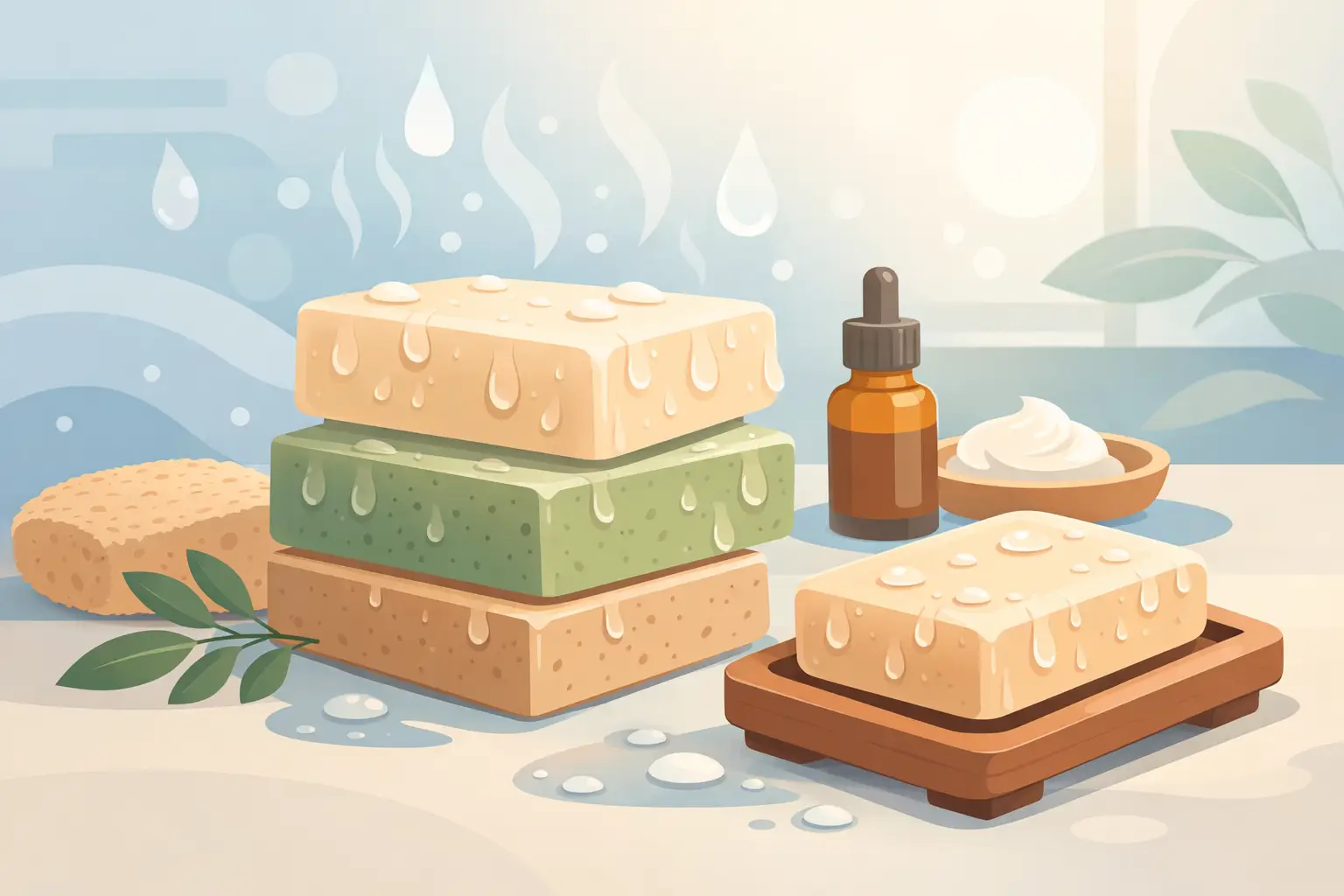
You unwrap a beautiful bar, set it by the sink, and a few hours later it looks as though it has tiny beads of water on the surface. If you have ever wondered why does handmade soap sweat, the short answer is this: your soap is pulling moisture from the air. It is common, usually harmless, and often a sign that your bar still contains the natural humectants that many commercial bars strip away.
That can feel a bit unsettling at first, especially if you have chosen handmade soap for its purity, gentleness, and traditional ingredients. But sweating is not usually a fault. It is more often the result of good soap meeting a humid environment.
Why does handmade soap sweat in the first place?
Handmade soap can “sweat” because some of its naturally occurring ingredients attract water. The main one is glycerine, a humectant created during the soapmaking process. Humectants draw moisture from the surrounding air, and when the air is damp enough, that moisture settles on the outside of the bar as visible droplets.
This is particularly noticeable in artisan soap because traditional makers often leave glycerine in the finished bar. That is part of what makes handmade soap feel kinder and more conditioning on the skin. Many mass-produced bars remove glycerine for use in other cosmetic products, which changes how the bar behaves.
So if your soap is sweating, it does not automatically mean it has gone off, been made badly, or contains too much water. In many cases, it simply means the air around it is humid and the bar is doing what naturally made soap tends to do.
What soap sweat actually is
The word “sweat” makes it sound as though the bar is leaking from within. That is not quite what is happening. The moisture you see is usually coming from the atmosphere, not pouring out of the soap itself.
When warm air holds a lot of moisture, and that moisture meets a cooler or hygroscopic surface, tiny droplets can form. In handmade soap, those droplets often sit on the outer layer of the bar. They can make the soap feel tacky, slightly soft, or glossy.
This is why sweating is often called glycerine dew. It is surface moisture, not spoilage.
Which handmade soaps are more likely to sweat?
Some bars are naturally more prone to sweating than others. Glycerine-rich soaps are the obvious example, but formulation matters too.
Melt and pour soaps usually sweat more than cold-process soaps because they often contain extra humectants to keep the base workable and clear. Cold-process soap can still sweat, especially in damp bathrooms, but it is often less dramatic.
Bars with added sugars, honey, certain milks, or moisture-loving botanicals may also react more quickly in humid conditions. A softer bar with a higher water content can feel the effects more noticeably than a very hard, long-cured one.
Traditional tallow soap, especially when properly cured, is usually firm and long-lasting. It can still develop surface moisture in the right conditions, but a well-made bar tends to hold up beautifully with sensible storage.
Humidity is usually the real culprit
If you are asking why does handmade soap sweat, it is worth looking at your room before you blame the bar.
Bathrooms are the perfect setting for soap sweat. Steam from showers, poor ventilation, condensation on windows, and warm indoor air all raise humidity. Even the loveliest artisan bar will struggle if it lives on a flat dish beside a steamy bath and never gets the chance to dry out.
Seasonal weather can make a difference too. A spell of muggy summer air, or a home that runs warm and damp through winter, can trigger sweating even if the soap was perfectly dry before.
This is one of those situations where the soap is only half the story. Environment matters just as much.
Is sweating a sign of poor quality?
Usually, no.
In fact, a bar that retains its natural glycerine may be more aligned with traditional soapmaking than one that looks perfectly dry in every condition. Handmade soap is a living sort of product. It responds to air, temperature, and storage because it has not been over-processed into something uniform and stripped back.
That said, there are trade-offs. A handmade bar can be more sensitive to its surroundings than a highly processed detergent bar. That is part of the appeal for many people – fewer harsh additives, more skin-friendly ingredients – but it does mean you need to treat it a little differently.
If the soap is persistently mushy, developing an odd smell, changing colour dramatically, or showing visible mould, that is a different issue. Simple sweating, though, is not the same as spoilage.
How to tell the difference between sweat and a problem
A sweating bar usually has clear or slightly cloudy droplets on the surface. Once wiped or left in a drier place, it often firms back up. The scent stays normal, and the soap still lathers and cleans well.
A problem bar behaves differently. It may feel slimy right through, not just on the outside. It might smell rancid, sour, or stale. In rare cases, poor storage can also lead to orange spots or discolouration linked to oxidation rather than humidity.
If in doubt, let the bar dry somewhere cool and airy for a day or two. If the moisture disappears and the bar feels sound, you are likely dealing with ordinary soap sweat.
How to stop handmade soap sweating
You cannot always prevent it entirely, especially in a humid home, but you can reduce it.
The biggest improvement usually comes from airflow. A draining soap dish is far better than a flat one that traps water underneath. Soap needs to dry between uses. When it sits in a puddle, softness and sweating get worse.
Storage matters for unused bars as well. Keep them in a cool, dry place away from direct steam and sunlight. A linen cupboard, bedroom drawer, or shelf outside the bathroom is often better than storing every spare bar beside the shower.
If a bar arrives slightly damp during humid weather, unwrap it and let it breathe. A bit of open air in the right environment often solves the issue.
For gift sets or stock you are keeping for later, breathable packaging can help. Completely sealing a bar while moisture is present may trap condensation rather than prevent it.
Why proper curing still matters
Even though humidity is the main trigger, cure time still plays a role in how a bar performs.
A properly cured soap has had time for excess water to evaporate and for the structure of the bar to harden. This leads to a firmer, longer-lasting soap that copes better with everyday use. It will not become immune to humid air, but it is generally less likely to turn soft at the first sign of steam.
This is one reason traditional soapmaking methods matter. Slow, careful production gives the bar time to become what it should be – stable, mild, and satisfying to use. At Luna Natural Soap Co., that kind of patience is part of the craft.
Does sweating affect how the soap works?
Most of the time, not in any meaningful way.
A sweating bar still cleanses. It still lathers. It still carries the character of its oils, fats, and added botanicals. The main difference is cosmetic and practical. It may not look as tidy on the shelf, and if it stays damp for too long, it may wear away faster.
For people with dry or sensitive skin, that is often a worthwhile trade. A traditionally made bar that keeps its natural glycerine can feel gentler and more comfortable than a harsher alternative that never sweats but leaves skin feeling tight.
The key is not chasing a perfectly dry-looking bar at all costs. It is choosing a well-made soap and storing it properly so you get the best from it.
A final word on why handmade soap sweats
Handmade soap sweats because it is honest soap. It still contains the naturally occurring elements that make it feel nourishing, and it still responds to the world around it. A little surface moisture is not failure. It is a reminder that real ingredients behave like real ingredients.
Give your bar airflow, keep it out of constant damp, and let it dry between uses. In most cases, that is all it needs to stay firm, beautiful, and ready for the next wash.