


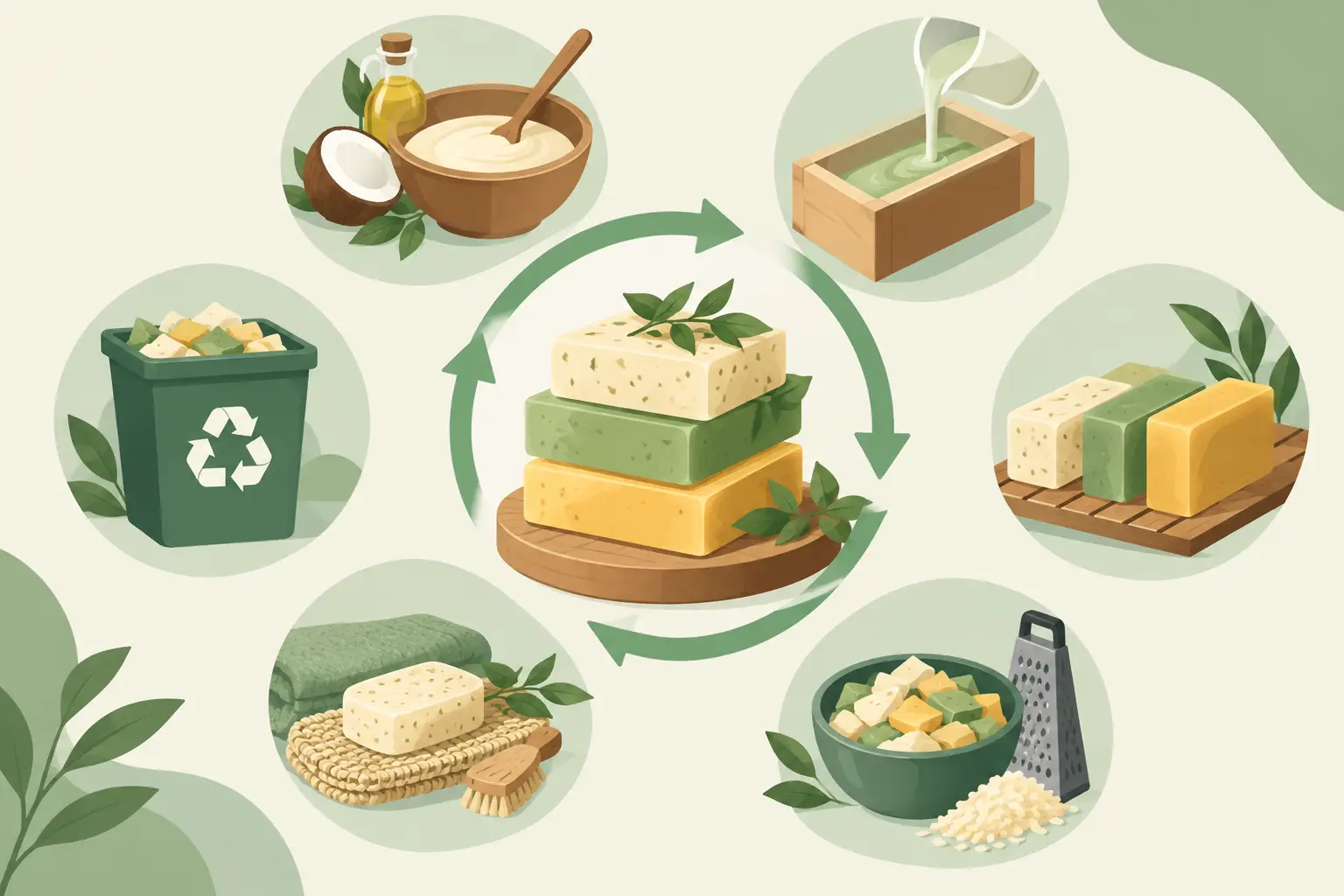
A beautiful bar of soap should not leave a trail of avoidable waste behind it. The most meaningful circular soapmaking examples begin long before a bar reaches the bathroom shelf: with considered ingredients, measured batches and a plan for every offcut. It is a practical approach to making less waste, not a promise that making soap has no impact at all.
For natural soapmakers, circularity is also about respect. Respect for the farmers who raise ingredients, the materials already available, the hands that make each bar and the customer who wants a product that works hard to the very end.
What circular soapmaking looks like in practice
Circular soapmaking keeps materials in use for as long as possible. Instead of treating surplus fat, imperfect bars, packaging or rinse water as automatic waste, the maker asks a better question: can this be reduced, reused, recovered or designed out next time?
That does not mean every material can be reused safely. Soapmaking involves lye, heat and careful hygiene, so certain residues must be handled responsibly rather than repurposed. Nor is the most circular choice always the one with the shortest-looking supply chain. A locally sourced ingredient with honest provenance, used fully and made into a long-lasting bar, can be a better choice than a fashionable ingredient with a hidden cost.
Here are seven grounded examples of how that thinking can shape a bar of soap.
1. Turning a local by-product into a valued ingredient
Grass-fed tallow is one of the clearest circular ingredients in traditional soapmaking. It is rendered from beef fat that might otherwise have little value beyond the food system. When sourced from regenerative or local farms and carefully rendered in-house, it becomes a purposeful base for a firm, creamy bar.
This is not about claiming that any ingredient is impact-free. Animal agriculture has a footprint, and responsible sourcing matters. The circular opportunity lies in using more of an existing resource, rather than demanding a newly grown, highly processed substitute simply because it is fashionable. Tallow also makes a hard bar with a rich lather, which can help it last well when stored dry between uses.
2. Designing recipes around ingredients that are already available
Circularity is often decided at the formulation stage. A recipe built around a long list of rare oils, colourants and active ingredients may look luxurious, but it can create purchasing, storage and expiry challenges for a small maker. A more thoughtful recipe uses a focused selection of ingredients with a clear job to do.
For dry or sensitive skin, that might mean a tallow-rich base chosen for a gentle, conditioning cleanse, paired with familiar additions such as oats or carefully selected botanicals. The point is not to make every bar identical. It is to avoid buying ingredients merely for a passing trend, then allowing half-used stock to languish on a shelf.
A smaller, intentional ingredient list also gives customers something valuable: clarity. You can understand what is in the bar, why it is there and whether it suits your skin.
3. Making soap ends part of the range
Even the most careful cutter produces end pieces. These smaller, uneven slices have the same soapmaking quality as the centre-cut bars, but they do not always fit the expected shape of a full-size bar. Sending them away as waste would make little sense.
Selling or sharing soap ends gives these pieces a useful second life. They are ideal for a guest bathroom, travel wash bag or anyone happy to enjoy good soap without needing a perfectly uniform bar. Kept in a small soap bag, several pieces can be used together with very little fuss.
This is one of the most visible circular soapmaking examples because it asks customers to value substance over symmetry. A soap end may be less polished in appearance, but it still offers gentle cleansing and a beautiful lather. Imperfection is not a fault when the product performs exactly as intended.
4. Using offcuts without compromising safety or quality
Not all offcuts should become soap ends. Some can be incorporated into a fresh batch as decorative embeds, provided the recipe, batch records and cure time are managed properly. Small pieces of fully cured soap can add colour and character to a new bar while keeping good material in circulation.
There are limits. A maker must not combine old and new soap casually, obscure ingredient information or use pieces from a batch that did not meet quality standards. Circular practice never comes before safety, accurate labelling or product consistency.
When it is done with care, however, reworked trimmings can create genuinely distinctive bars. The result feels handmade because it is: each piece carries a small trace of work that would otherwise have been discarded.
5. Choosing packaging that does less and protects enough
A naked bar is not always the most responsible answer. Soap needs protection during storage and posting, and customers need clear ingredient and safety information. The goal is not no packaging at any cost. It is the right amount of packaging, made from materials that are straightforward to recycle, compost where appropriate, or reuse.
Paper wraps, card sleeves and plastic-free postal materials can reduce reliance on single-use plastic while still protecting a handcrafted bar. Avoiding unnecessary layers matters too. A gift-ready product can feel special because of its quality, scent and thoughtful presentation, not because it arrives surrounded by excess filler.
For the customer, the final step is simple but useful: separate paper and card according to local recycling guidance, and reuse clean boxes for household storage or gifting where possible.
6. Making bars last longer at home
The most sustainable bar is the one that is fully used. A well-made cold-process soap can be long-lasting, but it needs a little care once it reaches the sink or shower. Water is the enemy of a bar left sitting in a puddle.
Use a draining soap dish or rack, and allow the bar to dry between washes. Keep spare bars in a cool, dry cupboard rather than a damp bathroom. When a bar becomes small, press it onto the next bar while both surfaces are slightly damp, or place the remaining pieces in a soap saver bag.
This is a modest habit with a real effect. When a bar lasts longer, fewer replacements are needed, and every ingredient, wrapper and delivery journey goes further.
7. Closing the loop through small-batch planning
Circularity is not only visible in the finished product. It also lives in the workshop. Small-batch production allows soapmakers to make according to demand, refine quantities and avoid producing more than can be sold while fresh and at its best.
Careful weighing reduces ingredient surplus. Accurate cutting plans reduce offcuts. Batch records reveal which bars are loved, which seasonal ideas should stay limited and where materials are being lost. Even choosing a solid tallow dish soap can be part of the same thinking: it offers a concentrated, plastic-free alternative to repeatedly buying liquid washing-up products in bottles.
At Luna Natural Soap Co., this is why traditional craft and waste reduction belong together. Slow-rendered tallow, practical formats and plastic-free choices are not separate ideas. They are part of making useful products with greater care.
Circular choices are better when they are honest
Circular soapmaking is not a badge earned by wrapping a bar in brown paper. It is a series of decisions, repeated over time: source thoughtfully, make only what is needed, use materials fully and help customers enjoy every last piece.
For your next bar, look beyond the label design. Choose one made with a clear purpose, keep it dry, use the ends, and let the smallest everyday ritual become a little less wasteful.