

A beautiful label can tell you a product is natural. Traceability tells you whether the story holds up. For anyone wondering how to assess skincare traceability, the useful question is simple: can the maker clearly explain where their ingredients came from, how they were handled, and who made the final product?
This matters most when you are choosing skincare for dry, sensitive or troubled skin. You are not simply buying a lovely bar for the bathroom. You are choosing what touches your skin every day, what enters your home, and what kind of supply chain your money supports.
Traceability is not about demanding a perfect journey for every petal, oil or mineral. Small makers work with seasonal harvests, changing suppliers and ingredients that travel further than anyone would like. It is about honest knowledge, clear responsibility and a willingness to show the work behind the product.
What skincare traceability actually means
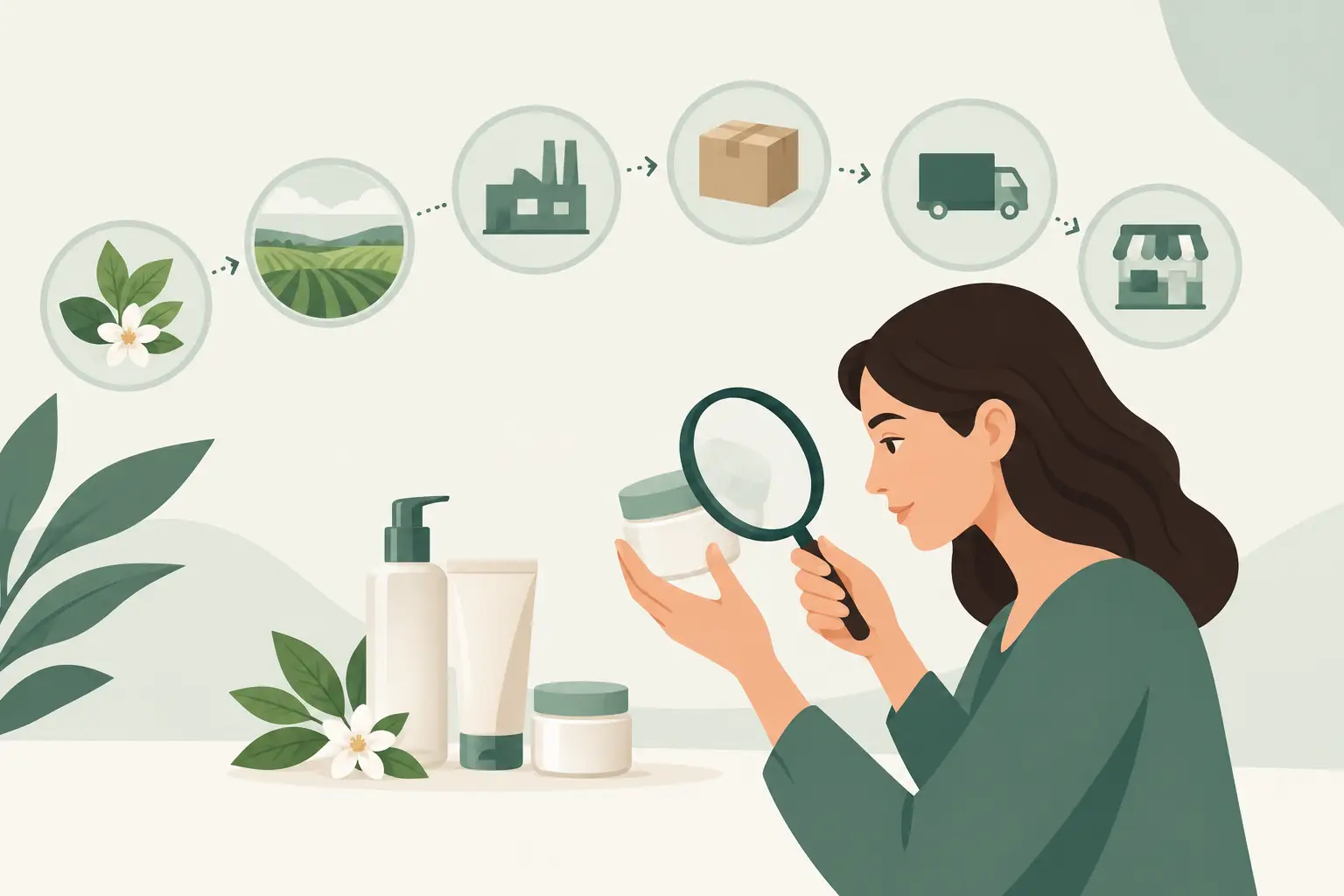
Traceability is the ability to follow an ingredient or product back through its supply chain. In skincare, that can include the farm, grower, processor, wholesaler, formulator, manufacturer and packer. The more stages a business handles itself, the more direct its knowledge can be – but every stage should still be accounted for.
A traceable product does not need to list a postcode for every ingredient. Some details may be commercially sensitive, and ingredients such as essential oils can be blended from several crops. What matters is whether the brand can give a meaningful answer when you ask where something comes from and why it was chosen.
For example, “made with natural ingredients” is broad. “Made with organic, grass-fed tallow from local regenerative farms, slowly rendered in-house” gives you something real to assess. It names the material, the standard, the source relationship and the process.
How to assess skincare traceability before you buy
Start with the ingredient list, but do not stop there. Ingredient names show what is in a product, not automatically where those materials were grown, processed or transformed. Look beyond the front-of-pack promises and see whether the brand provides a fuller account of its ingredients and methods.
A trustworthy maker usually communicates with calm specificity. They may identify key ingredients, explain their function in the formula and describe why the sourcing choice matters. A tallow soap maker, for instance, should be able to discuss the origin and handling of the tallow, rather than treating it as a vague by-product with no story behind it.
Ask yourself five practical questions:
- Can the brand identify the origin of its hero ingredients, at least by country, region or type of supplier?
- Does it explain meaningful standards such as organic, grass-fed, regenerative, fair trade or wild-harvested, rather than using them as decorative words?
- Is there clarity about who formulates and makes the product?
- Does the business acknowledge processing, including refining, rendering, extraction or preservation where relevant?
- Are packaging choices and end-of-life options described honestly?
You do not need a long essay for every answer. Short, direct information is often more useful than grand claims. The concern is not a lack of poetry. It is a lack of specifics.
Look for a clear chain of responsibility
The strongest traceability often comes from brands that know their supply chain closely. This may mean they make products in their own workshop, buy directly from growers, work with a small number of established suppliers, or process a key ingredient themselves.
There is a trade-off here. A local, small-batch brand may offer exceptional visibility over its core ingredients but use a botanical oil that cannot be grown in Britain or Ireland. That is not a failure. Shea butter, cocoa butter and many essential oils have legitimate places in natural skincare, provided their origin and sourcing standards are not hidden behind vague language.
Equally, a large company may have formal auditing and certification systems that a tiny maker cannot afford. Scale alone does not decide trust. Look at the quality of the information, the consistency of the claims and whether the company takes responsibility when the answer is complicated.
Check whether claims can be understood
Terms such as “clean”, “pure”, “ethical” and “eco-friendly” can reflect sincere values, but they are not traceability evidence by themselves. Ask what the claim means in practice.
If a product is described as organic, is that referring to one featured oil or the whole formula? If it is plastic-free, does that apply to the product packaging, postage materials and any labels? If an ingredient is locally sourced, is it produced locally, bought from a local distributor, or both? Precise language builds confidence because it allows you to make your own judgement.
Certifications can help, particularly for ingredients with complex international supply chains. They are not the only marker of integrity. Smaller farms may follow excellent practices without carrying costly certification, while certification does not replace a maker’s own understanding of what they buy. Treat it as one useful piece of evidence, not the entire answer.
Follow the ingredient that matters most
Every skincare product has a few ingredients that do most of the work. In a balm, that may be the main fat or oil. In a cold-process soap, it is usually the blend of fats and oils that creates the bar’s firmness, lather and cleansing character. In a botanical product, it may be the infusion or extract that gives it its purpose.
Assess those ingredients first. A brand should be able to explain why they use them, where they come from and how they are prepared. This is especially valuable with animal-derived ingredients. Responsible sourcing should cover animal welfare, farming practices, transport, rendering and the question of whether a material that might otherwise be discarded is being used thoughtfully.
At Luna Natural Soap Co., slow-rendering locally sourced, grass-fed tallow in-house creates a shorter, more visible chain between farm and finished bar. It also gives the maker direct control over an ingredient central to the soap’s skin-feel and performance. That is the kind of process detail worth seeking, whatever product you choose.
Do not forget formulation and batch making
Traceability is not only about the farm. A thoughtfully sourced oil can still be poorly stored, incorrectly measured or combined with ingredients that do not suit your skin. Good makers connect provenance with craft.
Look for signs that products are made in controlled batches and that the brand understands the limitations of its formulas. Cold-process soap needs time to cure. Natural colours may vary from batch to batch. Essential oils, however beautifully scented, are not automatically suitable for every sensitive skin concern. A confident maker will not pretend otherwise.
Batch numbers, best-before guidance and straightforward ingredient disclosures all support accountability. They tell you that the product is not just a concept or a marketing promise. It is a real item made through a repeatable process.
Assess the whole product, not only the ingredients
Traceability extends to packaging, too. Glass may be recyclable but heavy to transport. Paper can be renewable but may involve coatings that complicate recycling. Compostable materials are only useful where suitable facilities exist. There is rarely one flawless option.
The better question is whether a brand has made considered choices and explains them plainly. Plastic-free bars, minimal wrapping, recycled card and products designed to be used fully can reduce waste without asking customers to navigate unnecessary complexity. A soap-ends offering, for example, can turn perfectly usable offcuts into something practical rather than sending them to waste.
Also consider whether the product is proportionate to your needs. Buying a large collection of skincare that expires in a drawer is not more sustainable than buying a simple bar you will use every day. Traceability works best alongside mindful purchasing.
When information is missing
Not every brand will publish every supplier name. That is understandable. But if the only answers are broad phrases, repeated buzzwords or silence when customers ask reasonable questions, take that as useful information too.
You can contact a maker and ask about one or two key ingredients. Keep the question specific: Where is your tallow sourced? Is your olive oil traceable to a particular region? Who makes this product? How do you package it? A considered response is often more revealing than a polished product page.
The goal is not to catch a brand out. It is to support makers who are willing to be accountable, improve where they can and speak honestly about the choices behind their craft.
The next time a bar, balm or cleanser catches your eye, pause long enough to ask where its story begins. The answer should feel clear enough to trust, and grounded enough to matter.